Update on What you Need to Know on the Review Sheet – Feb 13, 2017
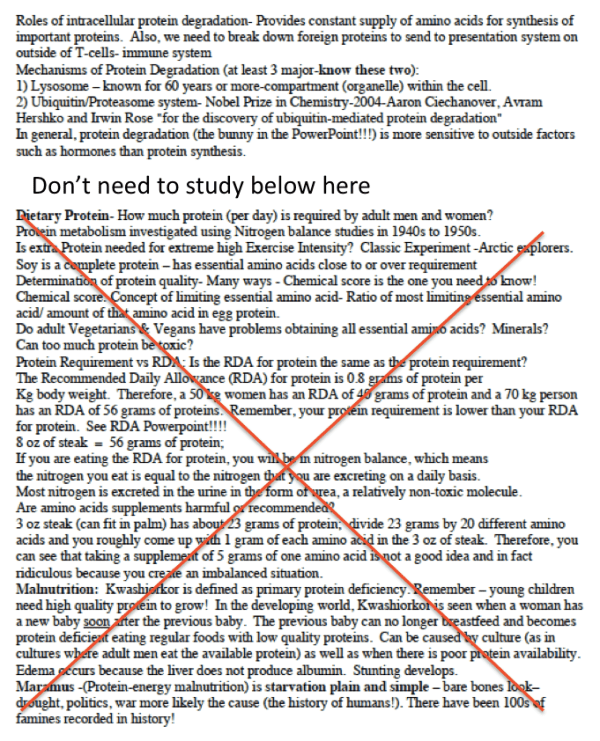
On page 3 of the Review Sheet, you do not need to know the Dietary Protein section:
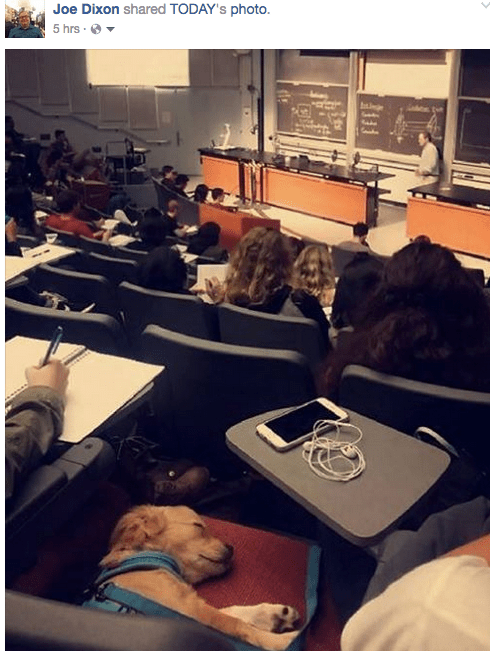
Great to have Dogs in Class – Feb 12, 2017
I love to have dogs in my class – even if they sleep through my lecture!


Proteins and Amino Acids – Chapter 5– Class 7 – Feb 7, 2017


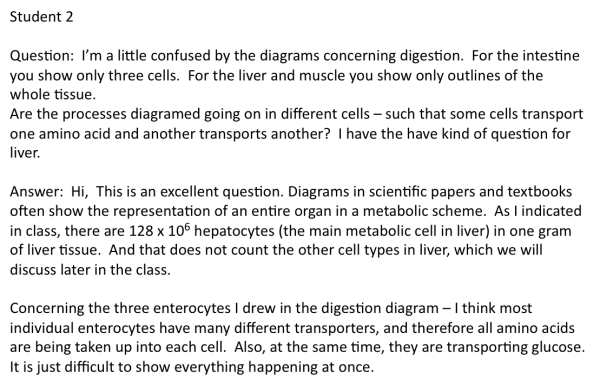
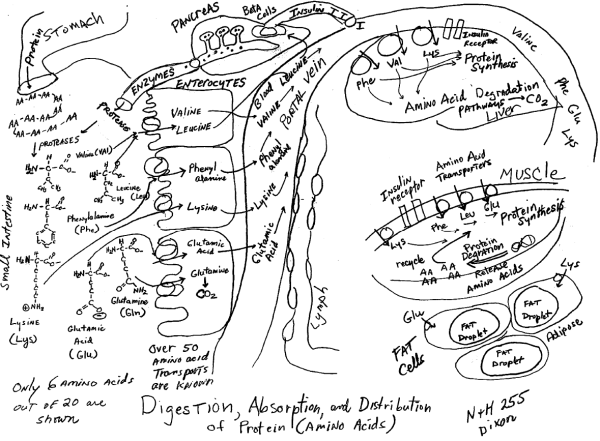
Digestion of Protein in the Small Intestine – Proteins are degraded by a family of proteases that are secreted from the pancreas. The resulting amino acids are transported into the enterocytes using many different transporters. In general, the overall scheme is not all that different from the digestion of starch and the uptake of glucose.

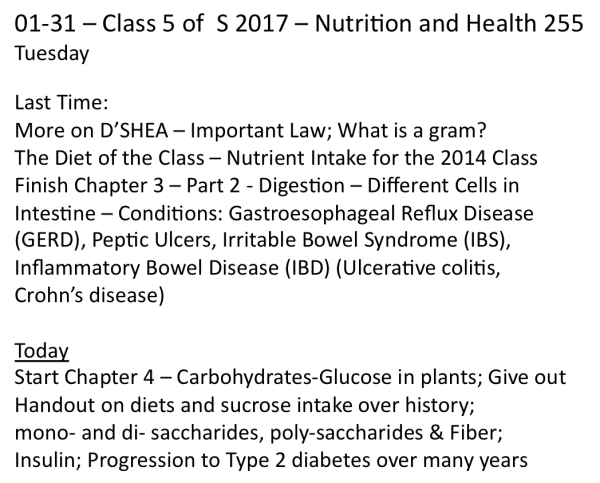
Digestion and Introduction to Carbohydrate Metabolism. Class 4, Jan 26, 2017

More on DRIs – How good is the diet of students in the class?
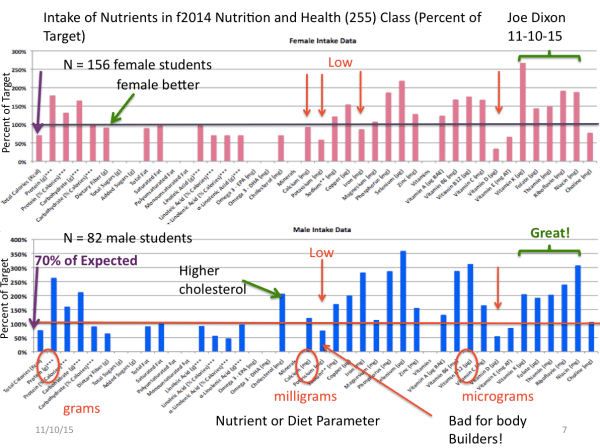
Dietary Assignment for 255 Class (Fall 2014); Joe Dixon, 11-10-15 version. This is data from the fall 2014 class!
Roughly the same number of students: Data was Analyzed by Sex
Female Students – 156; Male Students – 82
Data is expressed Mean Percent of Target DRI; Values as determined by USDA Program
Conclusions
In general, the class consumes a healthy diet that needs slight tweaking! No doubt, protein intake is sufficient! From the means of each group:
In women, calcium, iron, potassium, and vitamin D are low.
In men, fiber, potassium and vitamin D are low. Iron and selenium are high in men.
In both, sodium needs to be watched, but it is probably OK unless blood pressure becomes a problem.
Of course, please look at your own dietary survey to see if more substantial changes need to be made.
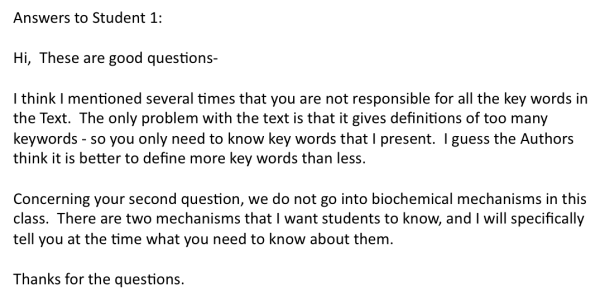
Answers to questions from two students:
Student 1: When we review the chapters, do we have to read everything or just the sections you’ve emphasized in the powerpoints?
My Answer: Thanks for the email. You have to read everything. But some sections can be read “lightly” and some have to be read more carefully – be sure you get the material etc. But you should read the chapters from the first page to the last!
Student 2: I am wondering what exactly we should take notes on in your class. You said that for the stuff in the book that you marked down as ” Read and Review” we should just read but we do not have to take extensive notes on, correct? Also, does that apply the topics in the book you note as important? Are we just reading it just to have a sense of what is going on? Do we take notes on what you put down on the slides?
My Answer (Possibly a little too long): Thank you for your email and the excellent question.
You are responsible for reading all assignments – if a chapter is assigned, my recommendation is that you read every word of the chapter. When I say read something lightly or review it fast or don’t take notes on this section, I mean that you should read the material, but do not spend a large amount of time on it rereading or taking extensive notes – but certainly you need to read it for comprehension.
When I say a section is important, I am indicating that this section is important to know and therefore you should read it until you understand it and feel confident you could be examined on it. I sometimes say in class that you should read important sections at least 10 x. This is a little bit of exaggeration, but what I mean is that if you wish to learn something you have to work at until you learn it.
Concerning what to take notes on – I usually indicate what I think is important in the lectures. If the material is in the lecture and in the text, then you should read both and try to cross reference and get a good handle on what the subject matter is. So far I have emphasized: Atwater numbers, DRIs, The 3 foundations of Nutrition, DSHEA, Where does energy come from?, and the role of oxygen in energy utilization. You can measure how much energy you use in any particular activity by measuring oxygen uptake etc. In whatever activity, the more physically fit you are, the higher you will be able to boost oxygen usage, and faster and longer you will be able to go.
So it is highly likely that I will ask questions on these topics. But of course, I can ask questions on anything that is in the readings or the lectures.
I was just reading that in one particular class, a professor assigned the students to read War and Peace by Tolstoy for the next week. That sounds impossible. I think the readings in Nutrition and Health are reasonable. The Text is very readable. So try to do the best you can!
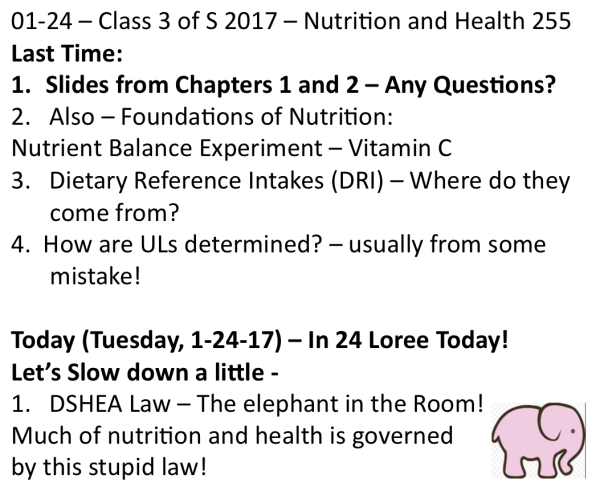
Where Does Energy Come From and How Is It Used? Class 3, Jan 24, 2017

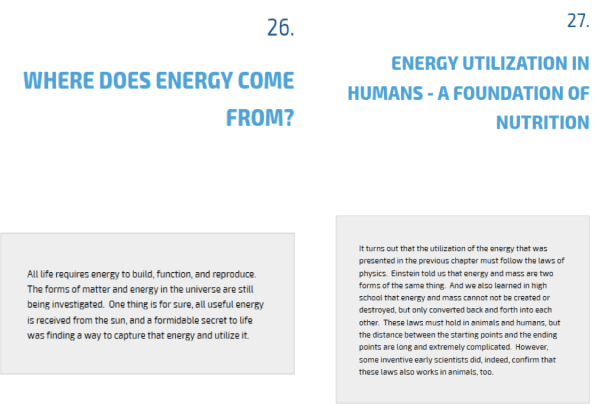
You can read about this Energy Lecture in Chapters 26 and 27 of my book!

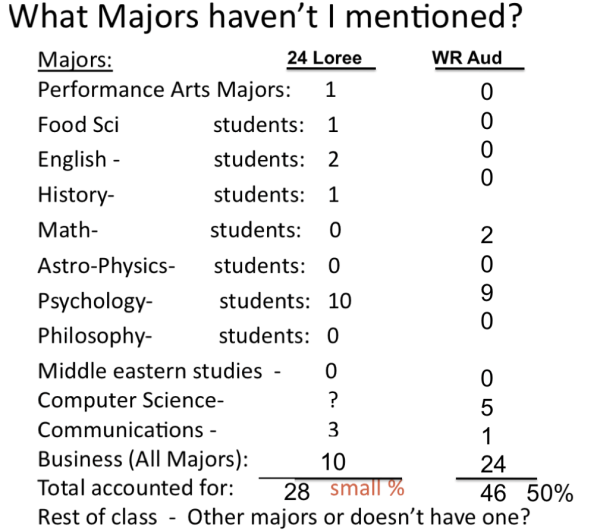
The Unofficial Class Survey is Complete – This will inform you of the level and the backgrounds of your classmates! 50% of the class is populated by non-Biological Science majors! A great shock to me is that the greatest major represented in our class is Business, followed by students with Exercise Science as their major!




 How to cure obesity
Recent Comments