Why You Have to Learn Some Chemistry in Nutrition and Health
Why do you need to learn some chemistry in Nutrition and Health? Actually, for many of you it will not be the first time you learned it and you might need to dig deep in your brain to freshen up the “chemistry neurons.” These are the reasons why all of you need to learn same basic chemistry:
First of all, you can all do it. I showed you the notes of a student who was a fine arts major and who received an “A’ in the class in fall 2014. And I mentioned that several years ago the top student in class was a Philosophy major! So I believe each and every one of you can learn the basic chemistry for this class.
Second, in the years ahead the most important area will be energy and how we obtain it and use it. A knowledgeable population is essential for the survival of the United States and the world. I wish I was kidding! Therefore, although you may not be a “science major,” Rutgers University dictates that you graduate a broadly educated person and, therefore, you need to fulfill a science requirement.
Third, I do not think you can understand nutrition in a truly meaningful way if you do not know some basic chemistry and metabolism. My favorite example of this is that it is relatively easy for cells to convert macronutrients into the same common metabolic intermediates. So when a media nutrition expert with essentially no science background whatsoever writes that this macronutrient is better for you than that macronutrient, you will have the knowledge and confidence to know that what he or she is saying is ridiculous and, in fact, insulting.
Nursing students need to know about metabolism and intermediates for them to really have an understanding of the drugs and diseases they are dealing with.
Lastly, our nutrition and dietetics students must learn chemistry if they are to be successful in their fields. My experience is that most learn–although some need to be coaxed along the way.
It is a challenge to teach so many students with different backgrounds, but as I mentioned when we discussed all the different areas the field of nutritional sciences encompasses, it is something I enjoy and somehow it works for most students in class.
So put those science caps on and let’s get to work!
Comments on the Vitamin C Depletion Experiment, Jan 27, 2015
Several students have asked for more information about the Vitamin C depletion experiment presented in class. Joe Dixon 1-27-2015
As I indicated in class, I was looking for this data for a long time and finally found it when I was browsing through a book. Many of the nutrient balance studies were performed in the first half of the 1900s. The reason for this is that the structure of DNA was not discovered until 1953 and the fields of molecular biology and molecular genetics were not even in place yet. So most research was in nutrition and nutritional biochemistry. Also, at this time scientists could put a human volunteer on a diet that was free or very low in a particular nutrient. Such studies are difficult to do today because of the ethical concerns.
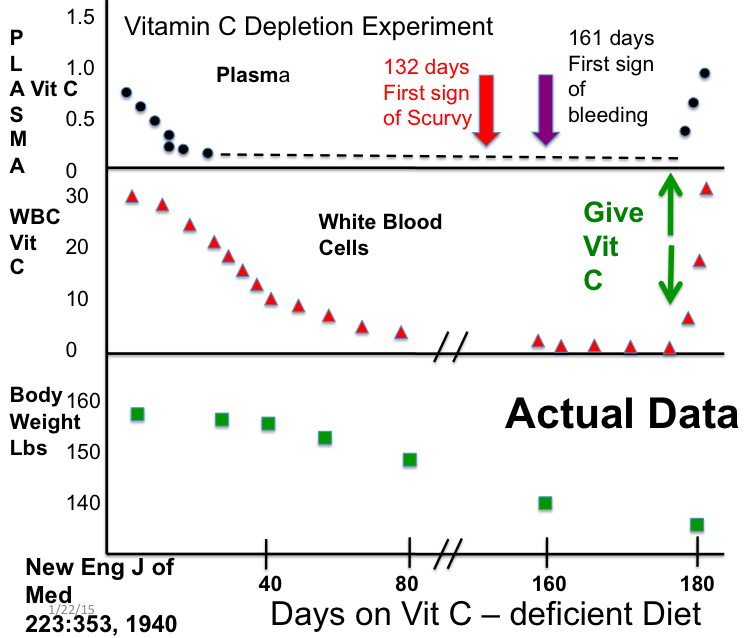
So in this experiment a male volunteer went on a vitamin C free diet to determine the effects. He was in a metabolic ward for most of the experiment. The scientists followed the levels of vitamin C in his blood and white cells and they also measured it in the urine. As the diagram depicted, the vitamin C concentration in the plasma (the water part of blood) decreased first (down to almost zero by 20 days) and the concentration in white blood cells decreased slower such that it took 60 days or so to get down to close to zero. This observation indicated that there was still vitamin C in the body even when the plasma levels were extremely low.
At 132 days on the vitamin C deficient diet the subject began to show signs of scurvy. Then bleeding started at 161 days. Finally at about 175 days the subject’s hemoglobin fell sharply and the doctors put the subject back on vitamin C because they were worried he might die.
So what happened here? Vitamin C is involved in keeping an enzyme active that helps form the protein, collagen. If vitamin C is deficient, this enzyme does not work properly and the functional form of collagen is not produced. Collagen is a protein that is secreted by cells and forms the matrix that holds tissues together – especially skin. If the collagen does not form properly, the tissues will tear easily and break apart.
So what happened in this subject? First of all we have to suspect that he was very healthy and that his collagen matrix was in good shape before he went on the diet. It is well known that the protein, collagen, is a long-term protein and turns over slowly. All proteins in the body “turn over.” What this means is that they function for a time and then the body degrades them to amino acids and forms new proteins from the resulting amino acids. I would guess that the fellow’s vitamin C was so low on about day 50 that he was no longer making new collagen in his entire body. However, the collagen that was already in place would last for a certain amount of time. The fellow showed signed of scurvy at day 132 so it took 132 – 50 = 83 days for the collagen to be a problem in his tissues. And then by day 161 he started to visibly bleed from different places.
I mentioned in class that the trip from the Netherlands to the tip of the Cape of Good Hope would sometimes take 2 months in a sailing ship, and that by the time the ship reached there many of the passengers and crew would have died of scurvy. The reason for this shorter time to get the disease was that many of the people back then probably ate very deficient diets and they were not that healthy when they started the voyage. They also may have had multiple vitamin deficiencies. Also, because the ships were very filthy, they may have cut themselves and obtained an infection and could not repair the skin because repair needs collagen. So the fellow that was in the metabolic ward of a hospital was able to go much longer on a vitamin C deficient diet than the passengers on early sailing ships.



Class on Friday, January 23, 2015
How do we know what is an adequate or safe intake of a nutrient?
A Nutrient Balance Study must be performed in humans to learn about the nutrient and to allow us to calculate how much of the nutrient is needed to maintain health.

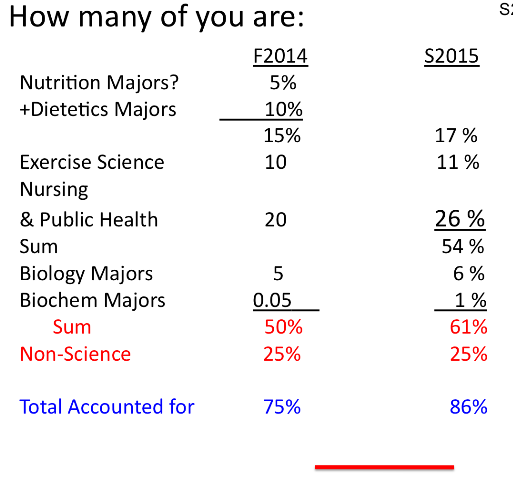
Results of Class Survey and Comparison to last Semester
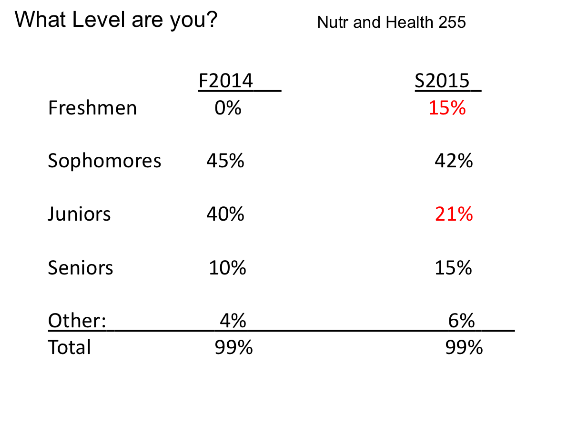
The class has a slightly different makeup this spring compared to the fall 2014 semester, but not as much as I initially thought. These data will help you size up the composition of the class! Quite interestingly, only 30% of the class has taken biology. I find this hard to believe but both semesters came out the same!


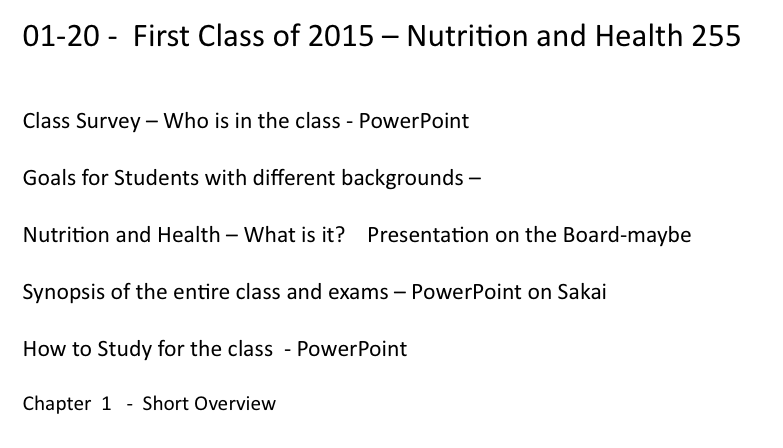
Class on Tuesday, January 20, 2015
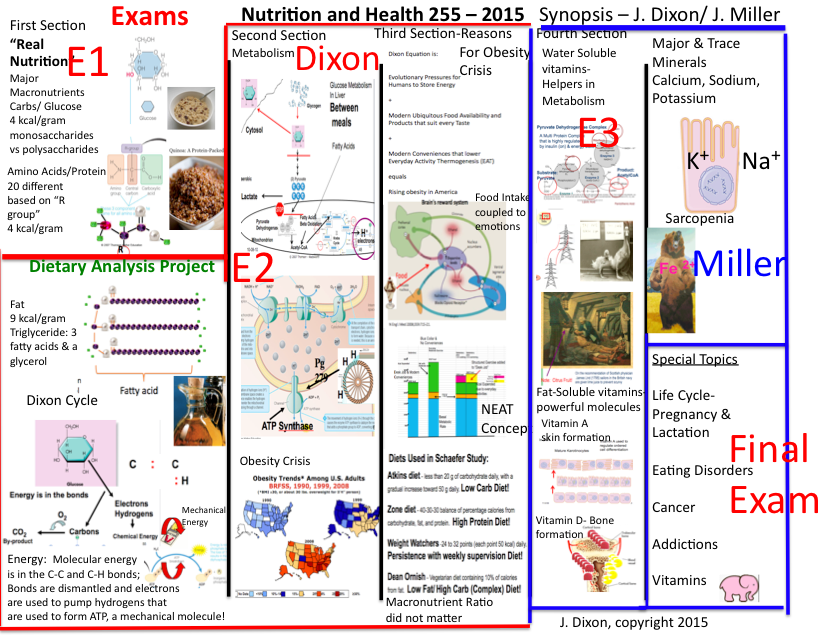
Nutrition and Health 709:255 – Spring 2015
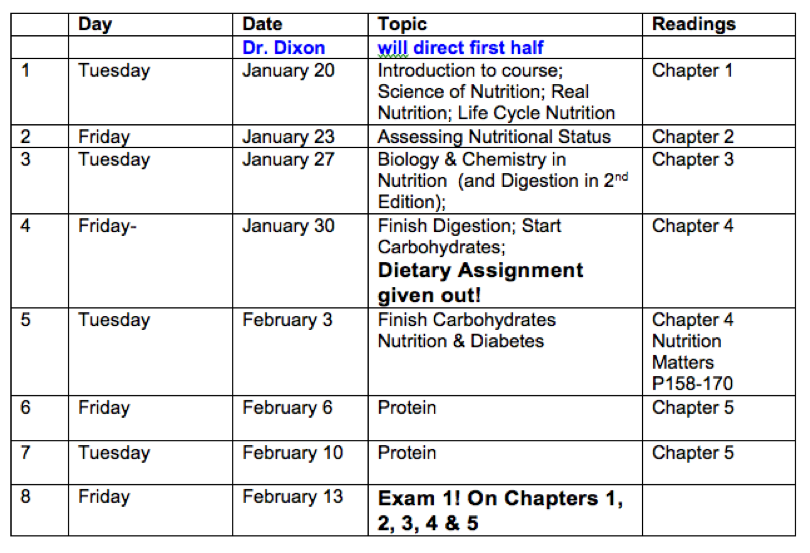
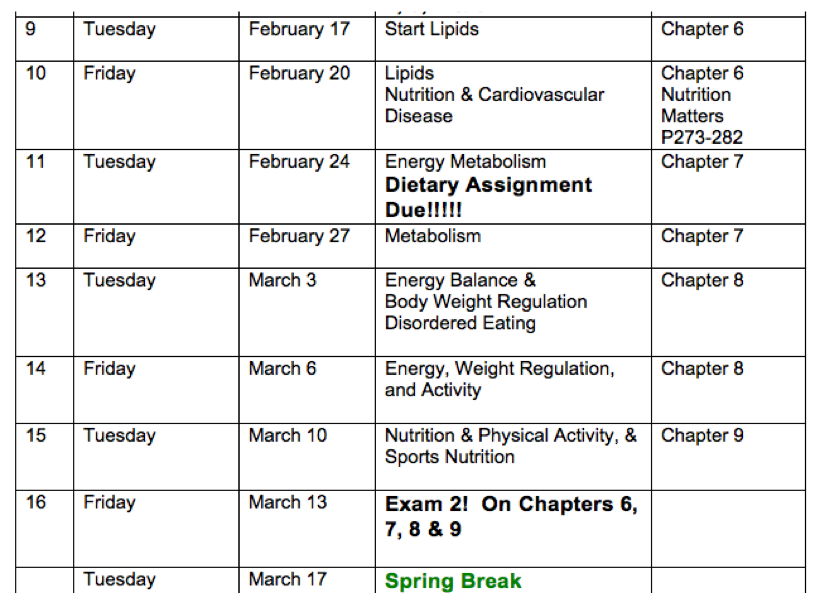
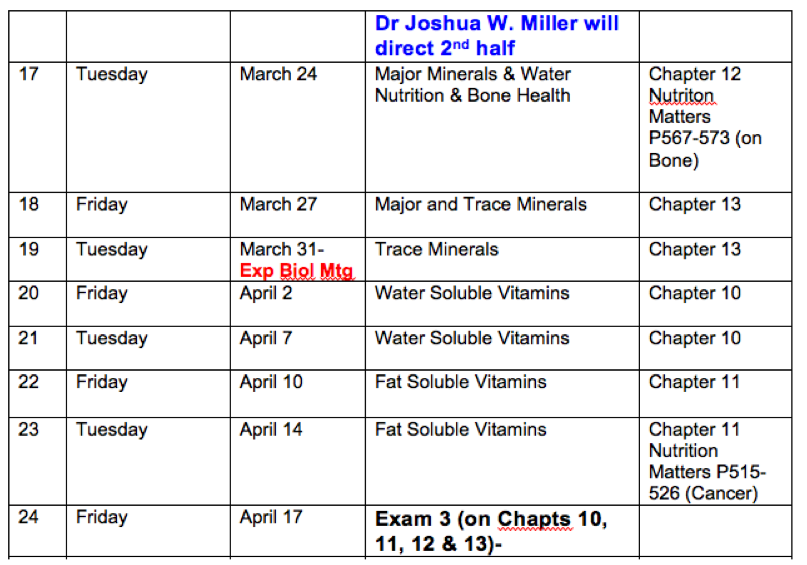
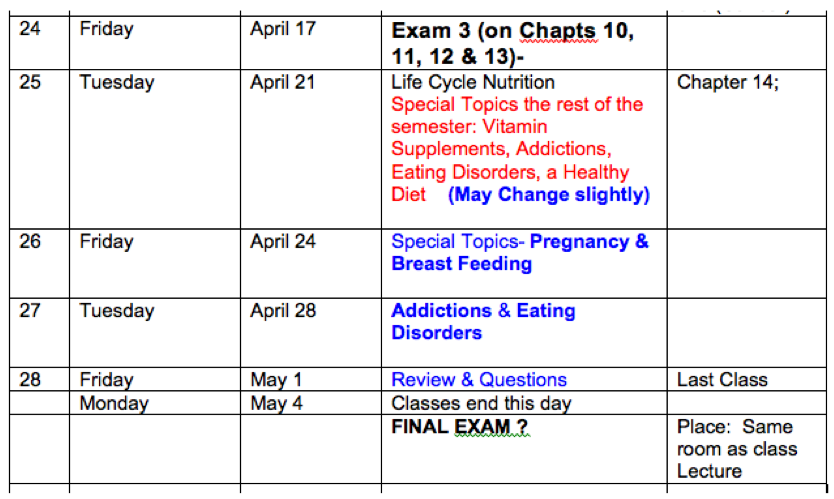
Schedule of Classes for Spring 2015
Class on Tuesday, December 9, 2014




Recent Comments