Class 7A – Nutrition and Health – What We Went Over About Carbohydrates
In today’s class (Tuesday, Feb 12, 2019 – lots of hail, snow and rain)) we went over three things:
-
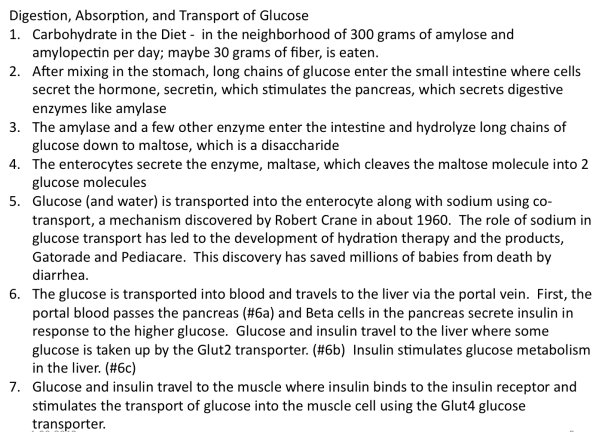
Reviewed Digestion of starch and absorption of glucose. Then we went over how glucose is distributed throughout the body. See presentation on Blackboard.
-
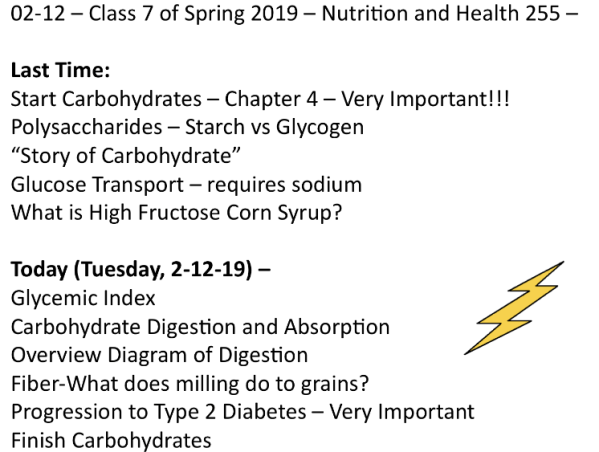
We talked glycemic Index and what are the factors that affect it.
-
We talked a little bit about fiber.



Class 7 – Nutrition and Health – Spring 2019 – Chapter 4 of McGuire – Finish Carbohydrates
There is class today, but attendance will not be taken and the lecture will be gone over very slowly and repeated on Friday for the most part. So if you have a long commute, don’t worry about attending. If you are near campus, come to lecture if you feel up to it. LOOK OVER THE LECTURE ON SAKAI AND READ THE TEXT. Exam 1 next Tuesday will only cover up to Chapter 4.
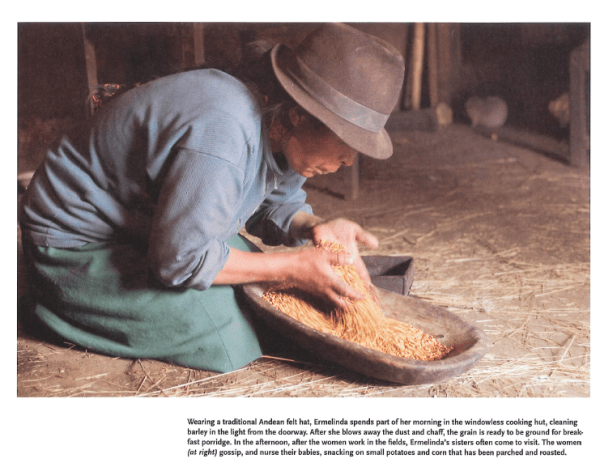
For most of Early Agriculture, grains were hand cleaned and ground using a mortar and pestle. Below is a photo from Mensel & DAluisio 2005 “Hungry Planet;” Chapter on Ecuador, page 107
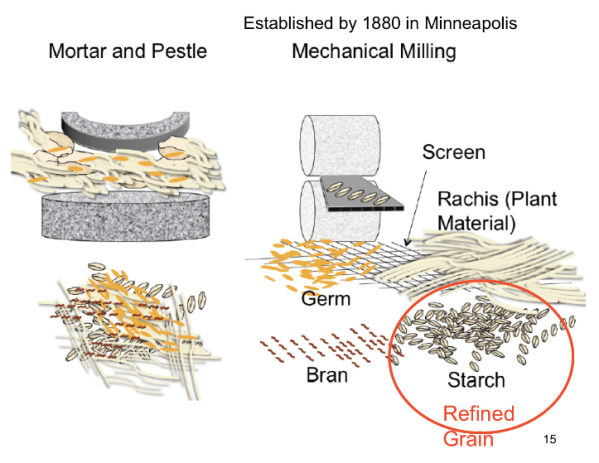
However, starting in about 1880, grains in the United States were ground using the steel roller milling machines. This is from my book, “The Obesity Explosion.”
“The mechanical roller milling machine was invented in Hungary
in the 1860s and later improved in several countries in Europe.4
The new method, the “Hungarian method,” included finely
spaced steel rollers, that could be adjusted to grind wheat into
different flour grades. The steel rollers lasted longer than the
grinding stones and could be adjusted to produce the desired
product. Also, they produced less heat than the large grinding
stones, and therefore the flour was not damaged or discolored
as much. The steel rollers were still driven by water power, but
they were far more easier to operate. An exhibition of milling
machines was held in Vienna in 1875 and companies from the
United States attended the meeting and realized that they needed
to quickly adopt the new method. The mill owners even sent spies
over to Hungary to get information on their technology. German
and Hungarian engineers were brought to the U.S. to establish
the technology here. Minneapolis had become the main grain
milling center in the U.S.; with over 20 stone grinding mills using
water power from the Mississippi River. But the new machines
were so efficient that by about 1880 almost all the mills had been
converted from stone grinding to roller milling.”
If you wish to read about the development of milling, read:
The Technology That Launched a City: Scientific and Technological Innovations in Flour Milling during the 1870s in Minneapolis https://www.jstor.org/stable/20188202
Class 6 – Nutrition and Health – Spring 2019 – Chapter 4 of McGuire – Start Carbohydrates

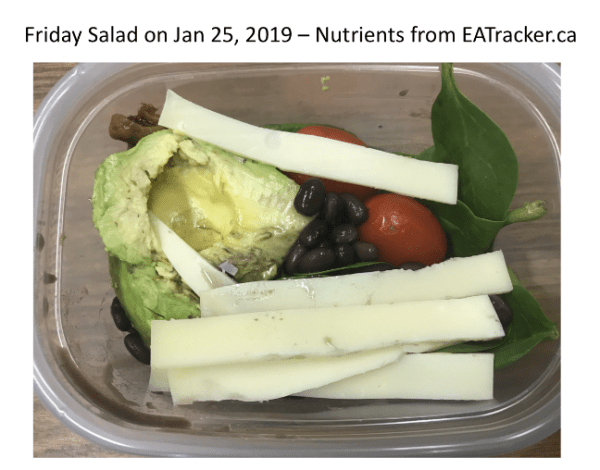
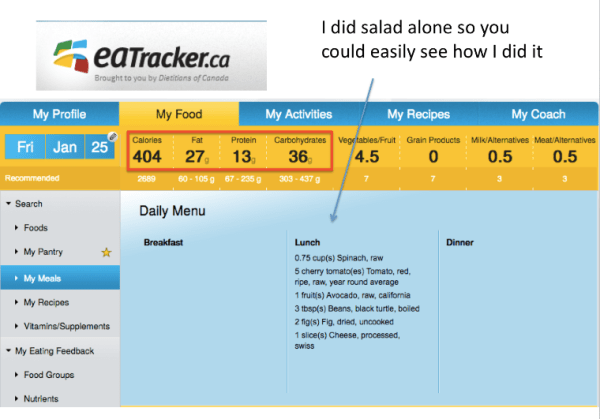
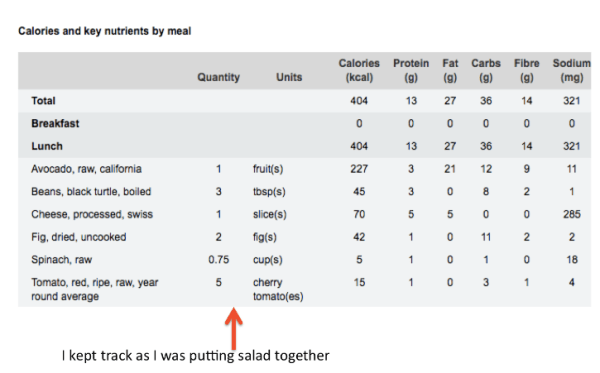
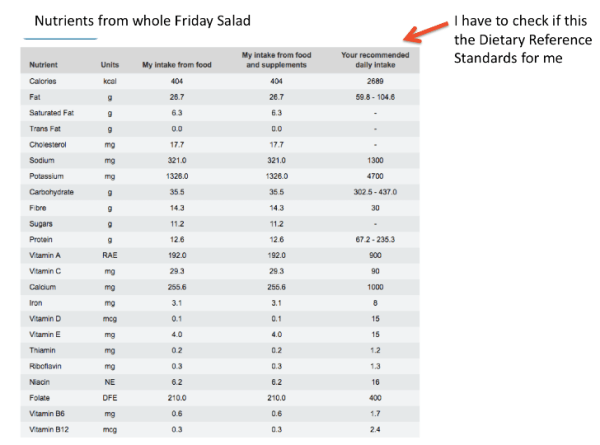
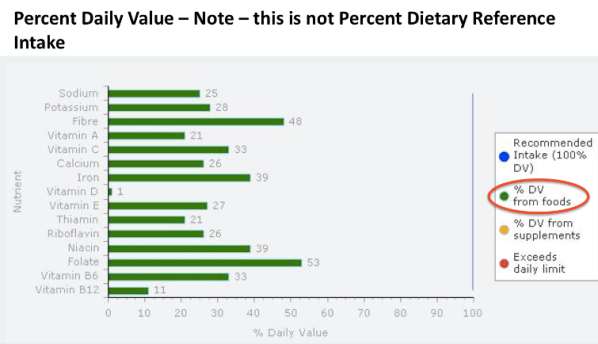
Salad Friday – similar to last week:

Low Carbohydrate vs Low Fat for weight loss:
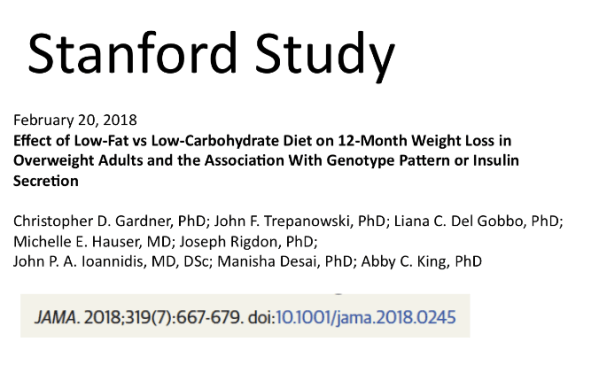
This article can be read for free at:
https://www.ncbi.nlm.nih.gov/pmc/articles/PMC5839290/


The most interesting part of this study is shown in the next figure. On both diets, people lost weight, people stayed at the same weight, and some people even gained weight! Why would this happen?

Go to the paper at this Website and read it if you are very interested!!
https://www.ncbi.nlm.nih.gov/pmc/articles/PMC5839290/
Class 5 – Nutrition and Health – Spring 2019 – Chapter 3 of McGuire – First Half – Energy


Why is there a Photo of a fire on the screen?

Warning: First Exam is on Tuesday, February 19th
Today: First TopHat Quiz (On Energy) – Quiz 1
How I will Handle TopHat grades:


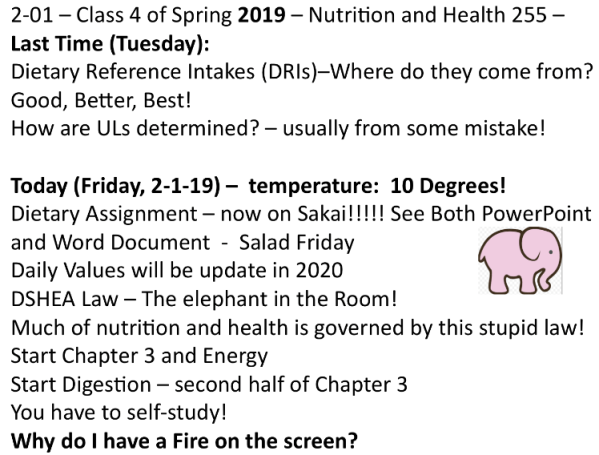
Class 4 – Nutrition and Health – Spring 2019 – Diet Assignment and Start Chapter 3 of McGuire
First – the Salad for Salad Friday – February 1, 2019; This salad was put together at the Harvest restaurant in the Institute of Food, Nutrition and Health




Class 3 – Nutrition and Health – Spring 2019 – Chapter 2 of McGuire and Beerman
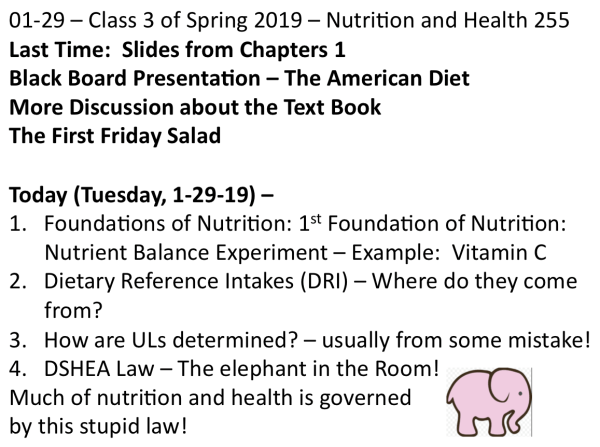
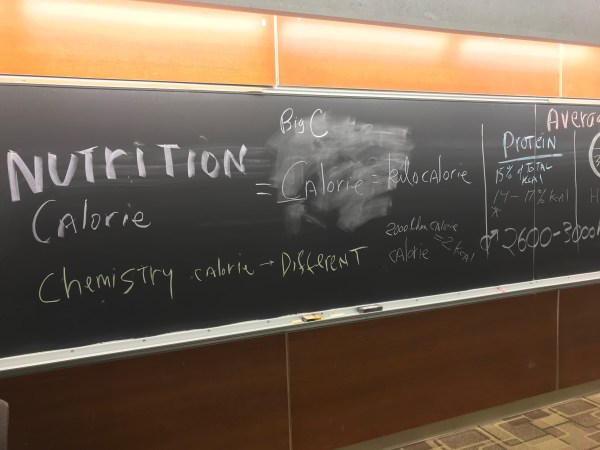
Photos of the Blackboard Presentation on 1-25-2019:

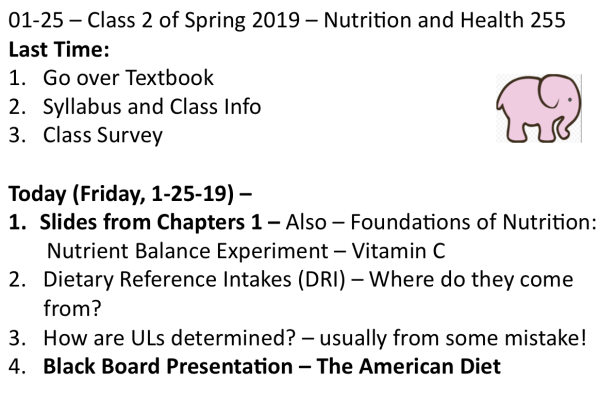
Class 2 – Nutrition and Health – Spring 2019 – Chapter 1 of McGuire and Beerman
Note about Order of Topics:
I follow the book very closely throughout the semester. The first two chapters of the book are fairly light and concern general information about Nutrition and how the Dietary Standards (Dietary Reference Intakes (DRIs)) were created and why. I add some information about the Foundations of Nutrition, which were developed in the late 1800s and early 1900s. Much excellent Nutrition research was done during these periods of time. One of the problems the “Media Nutrition Experts: have is that they do not realize this and thus do not know about this research. I have selected what I call the Three Foundations of Nutrition. These topics or breakthroughs were not the only research performed by the early researchers, but I consider them the most important. Without these three foundations, the rest of nutrition research would have been difficult to complete.
On the following Synopsis of the course, I highlight what portion we are doing right now and where we will head next.

Class 1 – Nutrition and Health – Spring 2019 – Welcome to Class
Welcome to the Class:
I wanted to say I am looking forward to class tomorrow. Every semester I try to do something different to make the class better. This semester I added TopHat to the class so as to get immediate feedback and to better track attendance. In order to makeup for some of the extra money you need to spend on TopHat, I went back to using primarily the solid Textbook, which you can probably get used for a very small amount. There must be hundreds on campus somewhere. You can still order the on-line version of the book if you prefer that. In order not to need the online version of the book, I found a free diet analysis program that is extremely easy to use and can be done from your phone. So we will no longer use the Textbook diet analysis program.
I have a blog for the course that can be accessed directly or through TopHat. The name is: https://howtocureobesity.com
On the blog I put the outline for the day’s lecture and some interesting tidbits I find here and there. If someone asks me a good question (which almost all are), I will answer it on the blog.
And finally, I use Sakai for resources, announcements, and for its gradebook.
Looking forward to a fun and productive class!
Joe Dixon


Textbook for the Course is 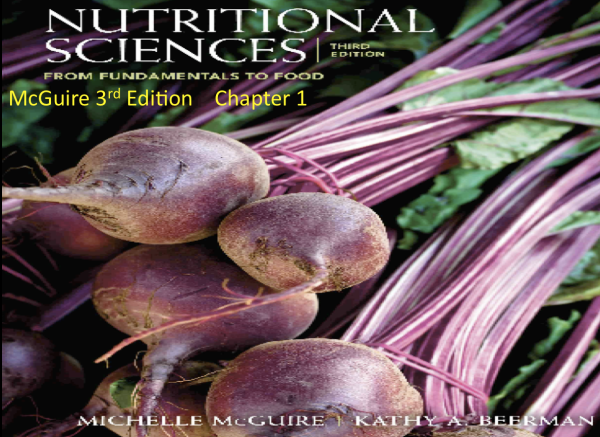
You can buy the Textbook used, new, or share it with a friend.
Also, it is available in the on-line Mind-Tap version.
But you must read the Textbook for this Course!
Macronutrients in the Diet
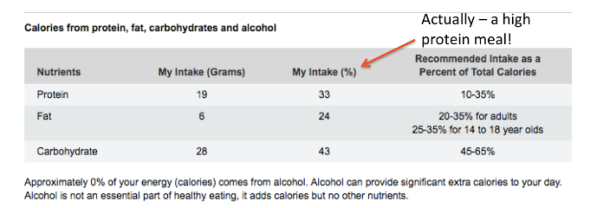
Over and over in the class I am going to refer to the macronutrients and what percent of Calories (calories written with a capital C is the Nutrition Calorie, or otherwise known as the kilocalorie (Kcal); the kilocalorie is equal to 1,000 chemistry calories (small c)). Today, the average intake of macronutrients in the U.S. is shown below. This is the mean of over what 300 million people consume. Each of us may have a different distribution for the diet we normally eat. However, it is a starting point and you need to know it.



 How to cure obesity
Recent Comments