Introduction to Carbohydrates, Insulin and Diabetes. Class 5, Jan 31, 2017

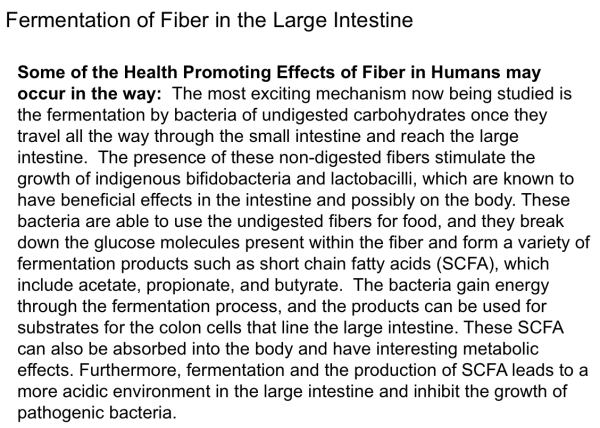
screen-shot-2017-01-31-at-3-54-07-am

Digestion and Introduction to Carbohydrate Metabolism. Class 4, Jan 26, 2017

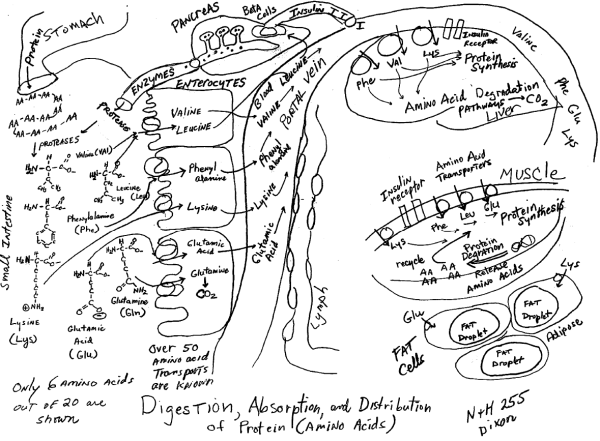
screen-shot-2017-01-25-at-10-54-37-pm

More on DRIs – How good is the diet of students in the class?

Dietary Assignment for 255 Class (Fall 2014); Joe Dixon, 11-10-15 version. This is data from the fall 2014 class!

Roughly the same number of students:  Data was Analyzed by Sex

Female Students – 156; Male Students – 82

Data is expressed Mean Percent of Target DRI; Values as determined by USDA Program

screen-shot-2017-01-26-at-7-42-49-am

Conclusions

In general, the class consumes a healthy diet that needs slight tweaking! No doubt, protein intake is sufficient! From the means of each group:

In women, calcium, iron, potassium, and vitamin D are low.

In men, fiber, potassium and vitamin D are low. Iron and selenium are high in men.

In both, sodium needs to be watched, but it is probably OK unless blood pressure becomes a problem.

Of course, please look at your own dietary survey to see if more substantial changes need to be made.


Answers to questions from two students:

Student 1: When we review the chapters, do we have to read everything or just the sections you’ve emphasized in the powerpoints?

My Answer: Thanks for the email.  You have to read everything.  But some sections can be read “lightly” and some have to be read more carefully – be sure you get the material etc.  But you should read the chapters from the first page to the last!

Student 2:  I am wondering what exactly we should take notes on in your class. You said that for the stuff in the book that you marked down as ” Read and Review” we should just read but we do not have to take extensive notes on, correct? Also, does that apply the topics in the book you note as important? Are we just reading it just to have a sense of what is going on? Do we take notes on what you put down on the slides?

My Answer (Possibly a little too long):  Thank you for your email and the excellent question.

You are responsible for reading all assignments – if a chapter is assigned, my recommendation is that you read every word of the chapter.  When I say read something lightly or review it fast or don’t take notes on this section, I mean that you should read the material, but do not spend a large amount of time on it rereading or taking extensive notes – but certainly you need to read it for comprehension.

When I say a section is important, I am indicating that this section is important to know and therefore you should read it until you understand it and feel confident you could be examined on it.  I sometimes say in class that you should read important sections at least 10 x.  This is a little bit of exaggeration, but what I mean is that if you wish to learn something you have to work at until you learn it.

Concerning what to take notes on –  I usually indicate what I think is important in the lectures.  If the material is in the lecture and in the text, then you should read both and try to cross reference and get a good handle on what the subject matter is.  So far I have emphasized:  Atwater numbers, DRIs, The 3 foundations of Nutrition, DSHEA, Where does energy come from?, and the role of oxygen in energy utilization.  You can measure how much energy you use in any particular activity by measuring oxygen uptake etc. In whatever activity, the more physically fit you are, the higher you will be able to boost oxygen usage, and faster and longer you will be able to go.

So it is highly likely that I will ask questions on these topics.  But of course, I can ask questions on anything that is in the readings or the lectures.

I was just reading that in one particular class, a professor assigned the students to read War and Peace by Tolstoy for the next week.  That sounds impossible.  I think the readings in Nutrition and Health are reasonable. The Text is very readable. So try to do the best you can!

Where Does Energy Come From and How Is It Used? Class 3, Jan 24, 2017

screen-shot-2017-01-24-at-12-21-50-am

screen-shot-2017-01-24-at-12-22-03-am

You can read about this Energy Lecture in Chapters 26 and 27 of my book!

screen-shot-2017-01-24-at-8-17-27-am

cover-obesity-explosion-w-asteroid-1-18-17


The Unofficial Class Survey is Complete – This will inform you of the level and the backgrounds of your classmates!  50% of the class is populated by non-Biological Science majors!  A great shock to me is that the greatest major represented in our class is Business, followed by students with Exercise Science as their major!

screen-shot-2017-01-24-at-12-22-15-am

screen-shot-2017-01-24-at-12-22-31-am


screen-shot-2017-01-24-at-3-59-48-pm


screen-shot-2017-01-24-at-12-23-12-am

Dietary Reference Intakes- Where Do They Come From? Class 2, Jan 19, 2017

01-19-class-2-of-2017


The Nutrient Balance Experiment – The Foundation of Nutrition


vitamin-c-depletion-exp-1-2015


People would die on long voyages due to Scurvy

sailing-to-cape-of-good-hope

Why Britannia Ruled the Waves

british-navy-given-limes

vitamin-c-experiment-2017-1

vitamin-c-experiment-2017-2

vitamin-c-experiment-2017-3


First Class of Nutrition and Health- Jan 17, 2017

Welcome to the Class!

first-class-01-17-2017-spring-semester

Synchronous Classrooms – Why?


Class Survey in 24 Loree – Are the Classes similar in composition?

loree-class-survey-1

loree-class-survey-2


loree-class-survey-3

loree-class-survey-4

loree-calss-survey-5

Goals for this Class

Student Comments from the Last Semester I taught (Fall 2015). All comments are on Sakai Site!


Synopsis of Class:

class-synopsis-in-spring-2017

exams-for-spring-2017

book-from-the-course-jan-17-2017


Today’s Salad, March 19, 2016

Screen Shot 2016-03-19  1

Screen Shot 2016-03-19  2

Screen Shot 2016-03-19  3

Screen Shot 2016-03-19  4


Last Class of the Semester, Tuesday, December 8, 2015

Screen Shot 2015-12-07 at 5.03.41 PM

Screen Shot 2015-12-07 at 5.07.36 PM

Screen Shot 2015-12-07 at 5.07.51 PM

Screen Shot 2015-12-07 at 5.08.00 PM

Screen Shot 2015-12-07 at 5.08.59 PM

Addictions and Eating Disorders, Class on December 4, 2015

Screen Shot 2015-12-02 at 9.06.20 AM

Question Concerning the Exercise Assignment

Question:   Just wanted to ask you about the kcal content of favorite snacks part of the exercise assignment. When we put down our favorite snack is it ok if I use a decimal? For example, I chose 1 cup of popcorn as one of my snacks and thats about 64 calories but when you convert it to kcal you get 0.064.

Answer:
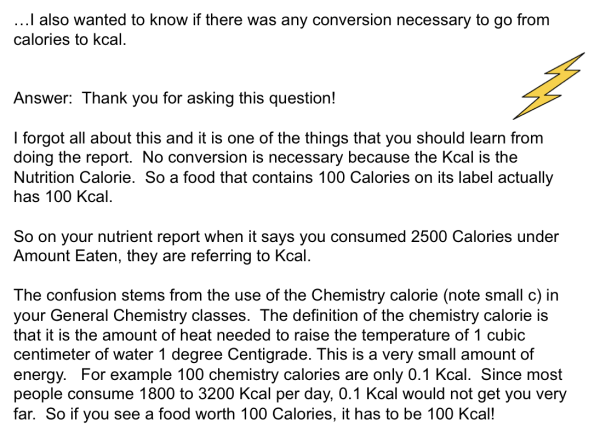
Thank you for your very important question.  The Nutrition Calorie is the Kilocalorie (Kcal).  If it wasn’t, then 1 cup of popcorn would be 0.064 Kcal as you say below.   How would it be possible that 1 cup of popcorn would provide less than one Kcal when your energy expenditure is something like 2000 Kcal?   If this were the case, you could eat 2000 cups of popcorn and still not reach your daily energy expenditure!   The ANSWER is that it is not possible, and in fact, the calories listed on the package are Kcal, and not calories (in small case). This is a very common misconception, and I am happy you brought it up!  Another student visited my office yesterday with the same question!


Special Topics In Nutrition, Class on Tuesday, December 1, 2015

Screen Shot 2015-11-30 at 6.01.19 PM

Screen Shot 2015-11-30 at 6.03.26 PM

Question Concerning Exercise Assignment

Question: I am a bit confused in what the first question is asking. Do you want us to compare the calories used vs the time or the calories used for structured activities vs walking?

Answer: Thanks for the question. I left it a little ambiguous which was a mistake. You can compare the specific Kcal expended per hour in a structured activity versus a basic, “NEAT”-type activity, or you could compare the total time spent in each type of activity on a daily or weekly basis and the general amount of Kcal expended. The second part of the first question is straight forward I think.

Questions on the Exercise Assignment, November 28, 2015

Here are some questions from students concerning the Exercise Assignment that was put on Sakai on Wednesday, November 25, 2015.

Question 1. What are structured Exercises and how do they differ from basic Exercises?

Answer: Structured activity is what you do in a gym or health club. Or maybe running or biking outside for a workout. Or doing exercises in your room for 30 minutes or so.

Basic or “NEAT” activities include walking and maybe gardening, working around the house, or going to the super market. Basic or “NEAT” may also include riding your bike to school or work.

On page 2 of the assignment, walking and gardening are basic or “NEAT” activities.

Question 2 (2 parts). For the 3rd page question one, are the structured activities the ones that are listed by you and we have to calculate? If yes then what would walking and basic activities be considered?

Answer: Structured activities are ones done in the gym or some kind of running or biking to get exercise. Walking, gardening and most kinds of working around the house or shopping are basic activities or “NEAT” activities. You can find the Kcal for NEAT activities on the Internet.

and for question #3,  where would we find the total energy expenditure calculated by the USDA?

Answer: You already have this calculation.   It would be the Target Calories (energy) at the top of the Nutrients Report in the USDA Print Out of your Dietary assignment!

Question 3. I have a question about the assignment. I’m a little confused with the calculations on the first page.
I calculated that my BMR is 2506 kcal/day
For PA, I chose Moderate exercise which says – Add 80% of BMR…….

Answer:   Already I think you made an error in calculating your BMR! Check your calculation.

Here is an example:   Say you are 60 kilograms (kg) (just an example).

Then your BMR per hr would be 0.9 Kcal/kg/hr  x 60 kg  =   54 Kcal/hr  (Use for page 2)
Then there are 24 hr in a day, so:

BMR = 54 Kcal/hr X 24 hr/day = 1,296 Kcal/day

for PA, add 80% of this, so 0.8 x 1,296 = 1037 Kcal/day

then TEF, use 10 % of BMR + PA which is =  0.1 x (2333)   =  233 Kcal/day

Then add them all up:    1,296 +  1037 + 233 =   2,566  Kcal, which is the total energy  expenditure ( or requirement).

Does that help?