Board Presentation on Tuesday, February 3, 2015
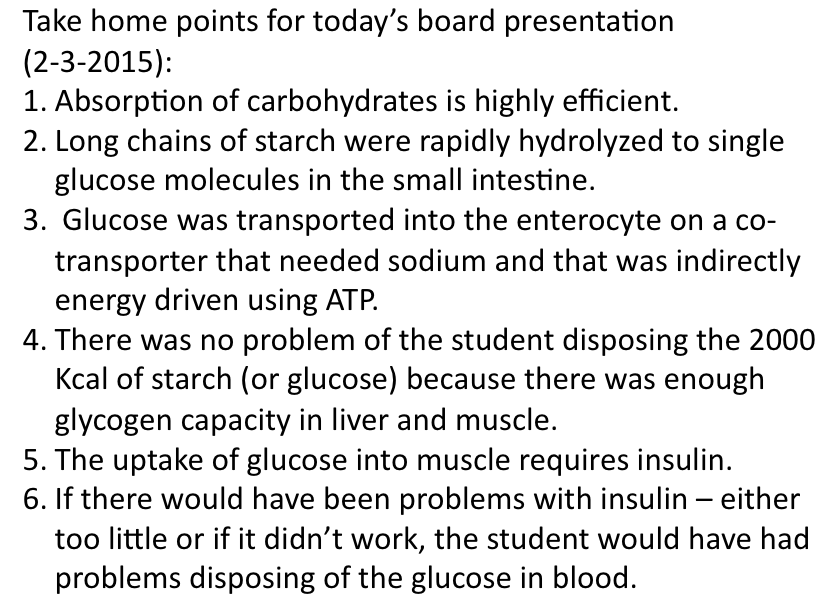
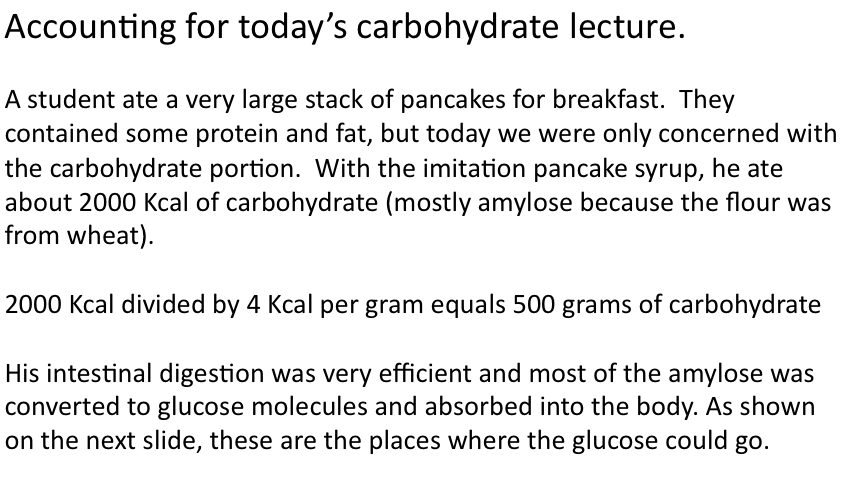
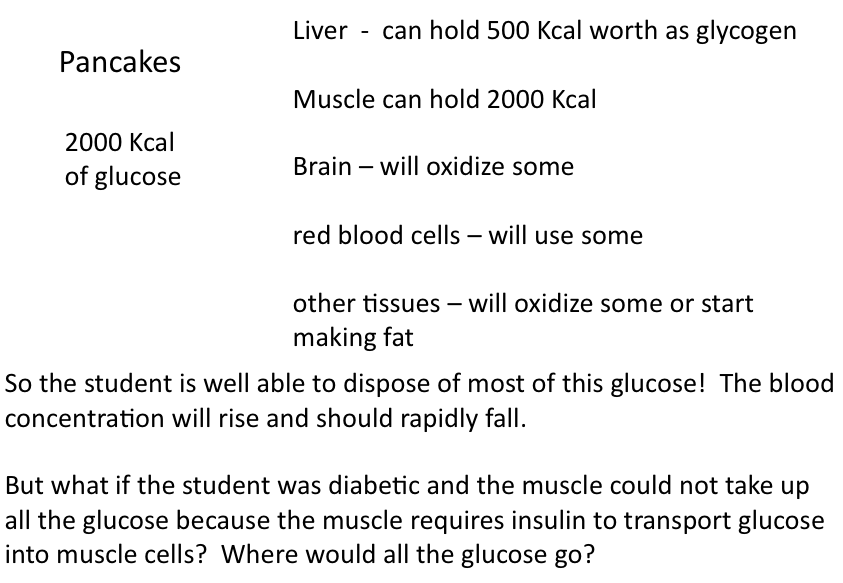
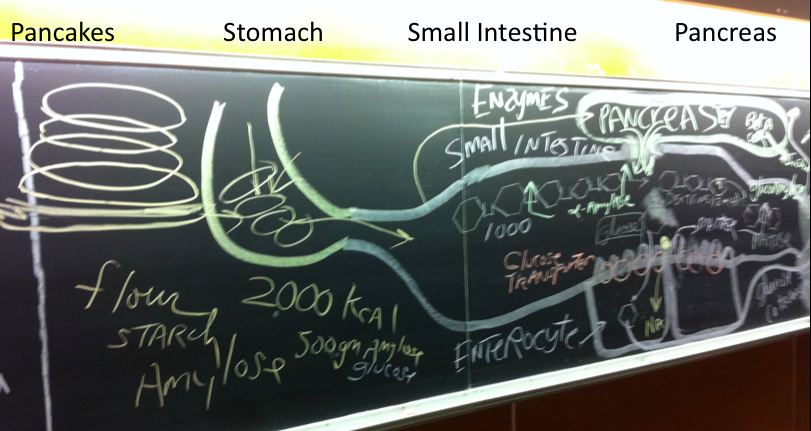
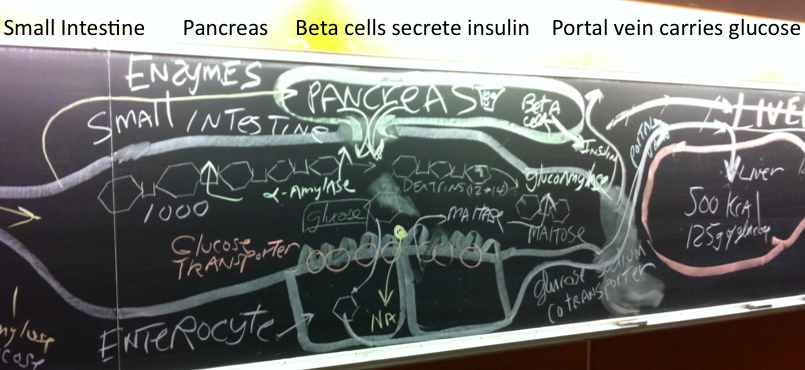
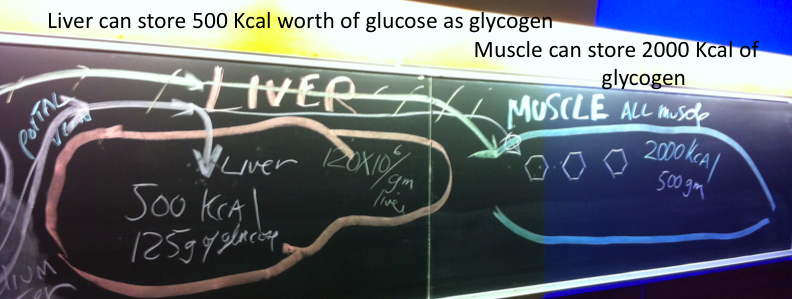
The Board Presentation on Tuesday, February 3, 2015 was an example of carbohydrate digestion and absorption after a full night’s sleep in a healthy individual who was not diabetic. The breakfast consumed, a stack of pancakes containing some 2,000 Kcal of carbohydrate, was certainly a large one but still possible. The student was well able to handle this much carbohydrate!
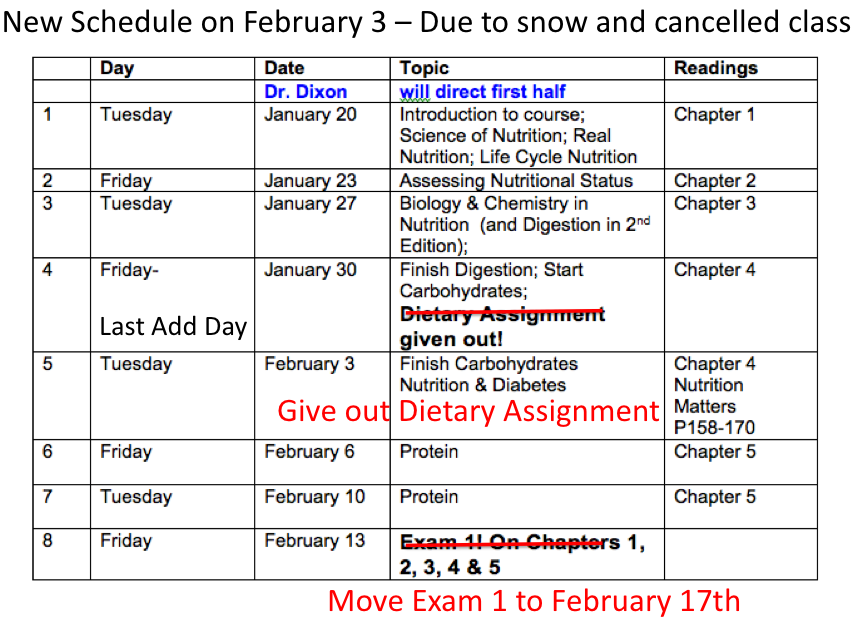
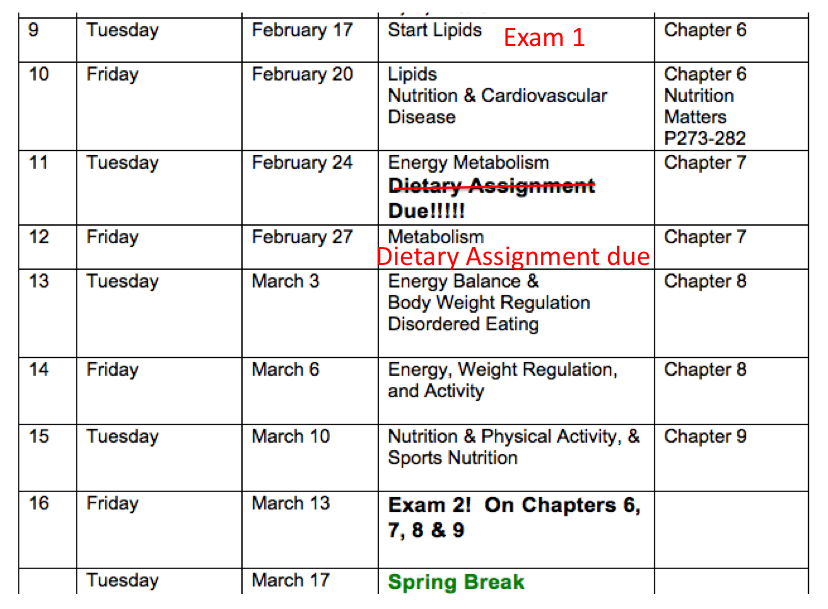
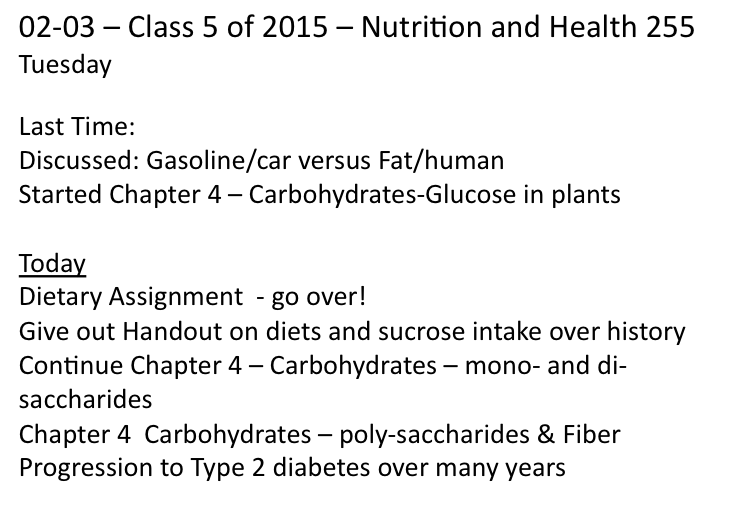
Updated Class Schedule on Tuesday, February 3, 2015
Please look closely at the updated class schedule!
Questions from an Inquisitive Student on February 1, 2015
Questions from an inquisitive student! I received this email from a student. These are great questions and she gave me permission to share them with you.
Professor Dixon,
I have some questions that I hope you can help me with:
1. What is the format of the test (multiple choice/short answer)? Ans: Multiple choice
2. Will there be diagrams that we have to label/recognize/interpret? Ans: Yes, maybe one per exam, but you will be fairly certain which one to prepare for.
3. Should we know all circled #’s, such as the energy burned (767 for a 10 mile run) and the numbers for Vitamin D and Selenium? Ans: For the entire class you have to know very few numbers – I will let you know the ones you need to know. There may be one or two that you will need to recognize on each exam, but not more than this, usually. You have to know the Atwater numbers. Also, you need to know certain percents having to do with the average American diet.
4. Ch 3 part 1- why is there a difference in energy for the bonds? Ans: It has to do with the characteristics of the atoms involved. Any more than this is beyond the scope of the class. But I am glad you are asking such amazing questions such as this.
5. What do we have to know about Rubner/Hess/Thornton – Ans: I do not ask about these on the exam – however, I wanted you to know that these very important foundations of nutrition were already worked out over 100 years ago.
6. I’m confused about what “first brain” refers to for the gi tract? Ans: I will address this in the next class – we have only had 3 classes! The first brain concept is something I dreamed up to explain why the intestine and the brain are so closely in touch.
7. Should we know the detailed processes of nutrient absorption (passive, active etc)? Ans: Only for glucose. There are over 50 transporters known for amino acids alone. If you wish to study all of these you are welcome to. But I really only ask you about glucose uptake, at least for now.
8. Should we know the detailed processes of pulmonary and systemic circulation or just generally what they are? Ans: In class on Friday I indicated that we are not covering this. Did you see that on the PowerPoint for the 2nd part of Chapter 3?
Energy and Nutrition, Blog from Class on January 30, 2015
Points from the Lecture on Energy. I presented some aspects of energy in nutrition but stopped because we will discuss this again in material for exam 2. However, I wish to give you the outline of the rest of the story now.
- Calories — This is a unit of measure for the energy form called heat. The nutrition calorie is, in fact, the kilocalorie (Kcal). The average intake in women is about about 2200 Kcal per day, and the average intake in men is about 2800 Kcal per day. Throughout the course the abbreviation Kcal is used. However, when I do use the full name calorie, I am referring to the Kcal. For those who study chemistry, the chemistry calorie is the one that can raise the temperature of 1 cubic centimeter of water one degree centigrade. Consuming 2000 chemistry calories would be equivalent to consuming 2 Kcal – this would not get you very far!
- A Kcal is a Kcal is a Kcal. The energy that is present within the major energy macronutrients is not changed when the macronutrients enter a human’s mouth. Anyone who states that, after food is consumed, the energy of one type of macronutrient is not utilized compared to the energy in another type of macronutrient is ignoring 100 years of the research that was performed on energy utilization in animals. Furthermore, they would have to violate several major Laws of Physics.
- But where is the energy?To find out where energy comes from in food, it is best to investigate some of the properties of fat.Fat is structurally similar to gasoline, and we know that gasoline is a source of energy as it can be used to propel very heavy automobiles around town. Both fat and gasoline are long chains of carbons with hydrogens attached (also known as hydrocarbons). Fatty acids have a characteristic carboxyl group at one end of the molecule, that gives it soap-like qualities. Gasoline lacks this carboxyl group. Gasoline actually contains many different unique chains of hydrocarbons. When each is burned in a bomb calorimeter, the energy content of fat and gasoline are fairly similar. Fat contains about 9 Kcal per gram. Gasoline contains about 11 Kcal per gram.
- Energy is in the bonds that hold the atoms together, with the carbon to carbon bonds having a relatively high amount of molecular energy. When the carbon–carbon bonds are broken, energy is given off. Let’s compare the energy evolved when these bonds are broken in fat and in gasoline.

- In class I went over the combustion of fuel in a fire. To start a fire, we need a fuel, oxygen, and ignition in order to start the chain reaction that is needed to sustain a fire. How is metabolism in animals similar to combustion in a fire?
a. Substrates can be the same (Say fat in cells & biodiesel in a fire)
b. Both require oxygen
c. Both produce H2O and CO2
d. Both have energy evolved from the bonds in the substrates and the energy is converted to a different physical form.
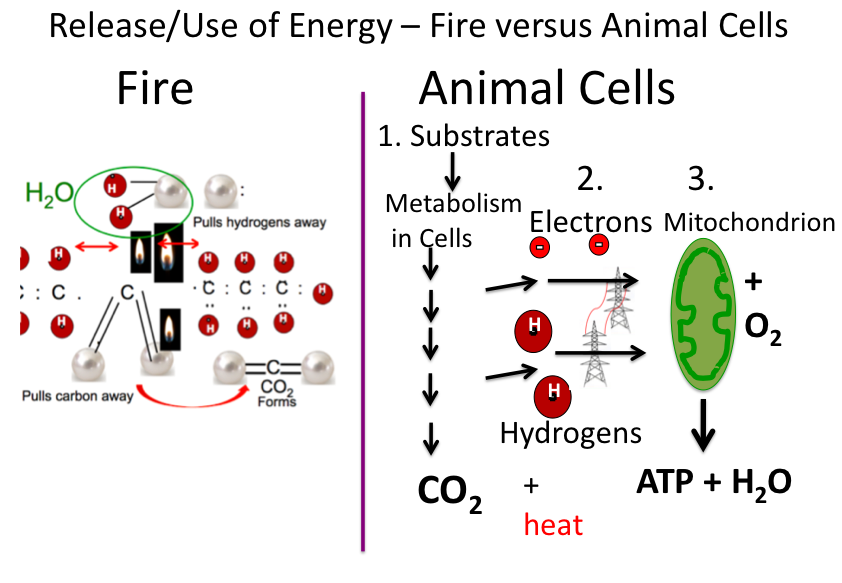
6. Let’s first go over the basics of the evolution of energy in cells. The cell needs fuel, oxygen, and metabolic enzymes to generate a usable chemical/mechanical molecule. The diagram below, which is very simple compared to what really happens in a cell, shows how cells utilize the energy in the macronutrients. (1) Cells break the bonds and dismantle the macronutrients using a series of enzymatic reactions. The carbons are converted to CO2 and the electrons and hydrogen atoms are transferred to the mitochondrion using a series of transport molecules and proteins (depicted by the power lines)(2). In the mitochondrion, the energy in the electrons are used to synthesize ATP, a molecule the cell can use for chemical and mechanical purposes. Finally the electrons and hydrogens unite with oxygen to form water (3).
After exam 1 we will discuss metabolism and the formation of ATP.
Why You Have to Learn Some Chemistry in Nutrition and Health
Why do you need to learn some chemistry in Nutrition and Health? Actually, for many of you it will not be the first time you learned it and you might need to dig deep in your brain to freshen up the “chemistry neurons.” These are the reasons why all of you need to learn same basic chemistry:
First of all, you can all do it. I showed you the notes of a student who was a fine arts major and who received an “A’ in the class in fall 2014. And I mentioned that several years ago the top student in class was a Philosophy major! So I believe each and every one of you can learn the basic chemistry for this class.
Second, in the years ahead the most important area will be energy and how we obtain it and use it. A knowledgeable population is essential for the survival of the United States and the world. I wish I was kidding! Therefore, although you may not be a “science major,” Rutgers University dictates that you graduate a broadly educated person and, therefore, you need to fulfill a science requirement.
Third, I do not think you can understand nutrition in a truly meaningful way if you do not know some basic chemistry and metabolism. My favorite example of this is that it is relatively easy for cells to convert macronutrients into the same common metabolic intermediates. So when a media nutrition expert with essentially no science background whatsoever writes that this macronutrient is better for you than that macronutrient, you will have the knowledge and confidence to know that what he or she is saying is ridiculous and, in fact, insulting.
Nursing students need to know about metabolism and intermediates for them to really have an understanding of the drugs and diseases they are dealing with.
Lastly, our nutrition and dietetics students must learn chemistry if they are to be successful in their fields. My experience is that most learn–although some need to be coaxed along the way.
It is a challenge to teach so many students with different backgrounds, but as I mentioned when we discussed all the different areas the field of nutritional sciences encompasses, it is something I enjoy and somehow it works for most students in class.
So put those science caps on and let’s get to work!
Comments on the Vitamin C Depletion Experiment, Jan 27, 2015
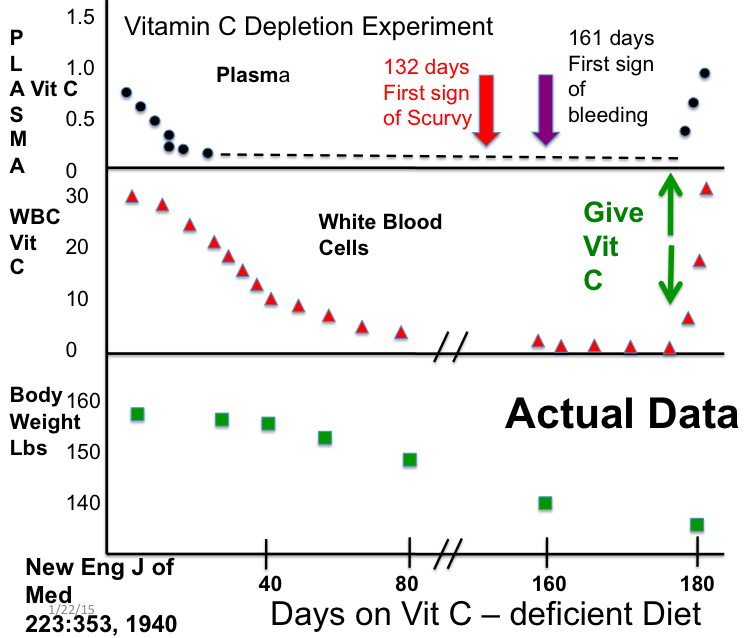
Several students have asked for more information about the Vitamin C depletion experiment presented in class. Joe Dixon 1-27-2015
As I indicated in class, I was looking for this data for a long time and finally found it when I was browsing through a book. Many of the nutrient balance studies were performed in the first half of the 1900s. The reason for this is that the structure of DNA was not discovered until 1953 and the fields of molecular biology and molecular genetics were not even in place yet. So most research was in nutrition and nutritional biochemistry. Also, at this time scientists could put a human volunteer on a diet that was free or very low in a particular nutrient. Such studies are difficult to do today because of the ethical concerns.
So in this experiment a male volunteer went on a vitamin C free diet to determine the effects. He was in a metabolic ward for most of the experiment. The scientists followed the levels of vitamin C in his blood and white cells and they also measured it in the urine. As the diagram depicted, the vitamin C concentration in the plasma (the water part of blood) decreased first (down to almost zero by 20 days) and the concentration in white blood cells decreased slower such that it took 60 days or so to get down to close to zero. This observation indicated that there was still vitamin C in the body even when the plasma levels were extremely low.
At 132 days on the vitamin C deficient diet the subject began to show signs of scurvy. Then bleeding started at 161 days. Finally at about 175 days the subject’s hemoglobin fell sharply and the doctors put the subject back on vitamin C because they were worried he might die.
So what happened here? Vitamin C is involved in keeping an enzyme active that helps form the protein, collagen. If vitamin C is deficient, this enzyme does not work properly and the functional form of collagen is not produced. Collagen is a protein that is secreted by cells and forms the matrix that holds tissues together – especially skin. If the collagen does not form properly, the tissues will tear easily and break apart.
So what happened in this subject? First of all we have to suspect that he was very healthy and that his collagen matrix was in good shape before he went on the diet. It is well known that the protein, collagen, is a long-term protein and turns over slowly. All proteins in the body “turn over.” What this means is that they function for a time and then the body degrades them to amino acids and forms new proteins from the resulting amino acids. I would guess that the fellow’s vitamin C was so low on about day 50 that he was no longer making new collagen in his entire body. However, the collagen that was already in place would last for a certain amount of time. The fellow showed signed of scurvy at day 132 so it took 132 – 50 = 83 days for the collagen to be a problem in his tissues. And then by day 161 he started to visibly bleed from different places.
I mentioned in class that the trip from the Netherlands to the tip of the Cape of Good Hope would sometimes take 2 months in a sailing ship, and that by the time the ship reached there many of the passengers and crew would have died of scurvy. The reason for this shorter time to get the disease was that many of the people back then probably ate very deficient diets and they were not that healthy when they started the voyage. They also may have had multiple vitamin deficiencies. Also, because the ships were very filthy, they may have cut themselves and obtained an infection and could not repair the skin because repair needs collagen. So the fellow that was in the metabolic ward of a hospital was able to go much longer on a vitamin C deficient diet than the passengers on early sailing ships.


Class on Friday, January 23, 2015
How do we know what is an adequate or safe intake of a nutrient?
A Nutrient Balance Study must be performed in humans to learn about the nutrient and to allow us to calculate how much of the nutrient is needed to maintain health.


 How to cure obesity
Recent Comments