




Questions Concerning the Dietary Assignment, September 23, 2015
I received these great questions concerning the dietary assignment. The answers are below.
“Hello Professor! I am just working on the Dietary Assignment and I had a couple of questions:
1) So when you say something needs to be “on one side of one page,” you mean that you want it to be a single sheet of paper, one sided? I am confused because I thought you meant that on one side you wanted for an example, the excel sheet and on the other side you want something else such as the nutritional report which would total to be one page since it is double sided
2) Additionally to confirm, you want a meal summary report, a nutrient report, a hand written food activity record and the typed questions? And all this should be on its own sheet of paper, only front sided?
3) Lastly, for the hand written food activity record, it will contain the same meals as the ones entered on into the website, correct?
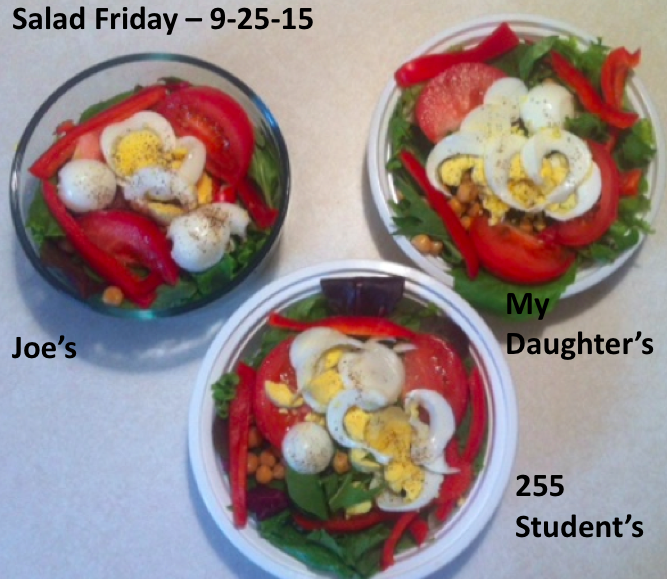
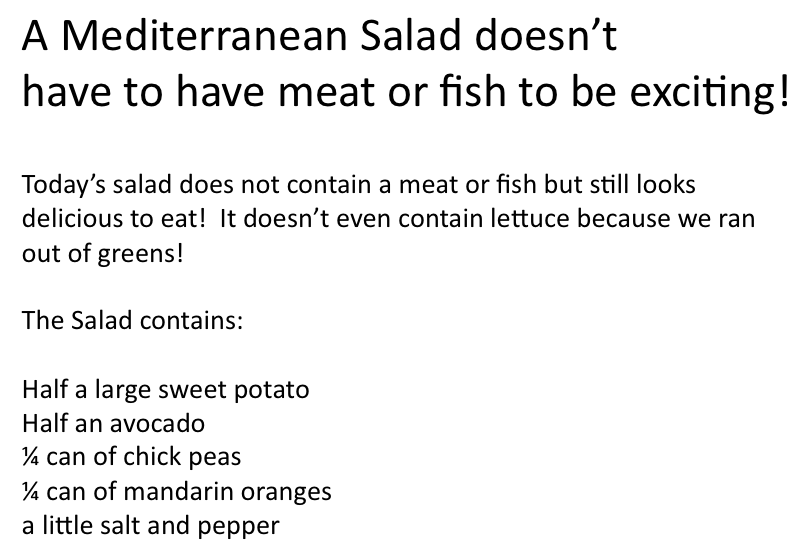
Sorry for all these confusing questions, just wanted to clarify! Hope you have a great week and I will see you Friday. Looking forward to your Mediterranean salad give-away.”
Answers:
Hi! These are great questions. Your #2 below is absolutely correct – you just need those 4 things for the assignment.
The only item that specifically needs to be on one side of one sheet is the Nutrients report. Most people have no trouble with this. In some cases people have taped the nutrient report on one side and that is OK. If the paper is a little big you can fold over the paper. The reason for having it on one side is that it makes it much easier for us to grade. Also, it is easier for you to get the whole picture concerning your dietary intake. Make sure every nutrient is printed out!
The hand written diet record should match the meal summary sheet. It is a little difficult to input the data for every single item and you have to make sure something you wrote down made it into the program. After all, you want to get a correct picture of your diet! So check you meal summery sheet with the diary. If you forgot something go back and edit the input.
Thanks for your questions! Joe Dixon
More on Glucose and Diabetes, September 23, 2015
Last time I gave more information on glucose transporters in order to answer two questions that were asked in class. There was another question that was asked by a student that I couldn’t think of the answer right away. The question was, “Why does the intestinal brush border glucose transporter requires sodium as a co-transporter?” This is a why question, and I’ll do my best to answer it. We already know that the sodium gradient provides energy for the transport of glucose into the enterocyte. There is very little sodium in the cytoplasm of the enterocyte, and so the flow of sodium ions into the enterocyte flows from a high concentration in the lumen to a very low concentration inside the enterocyte. But why is glucose transport linked to sodium transport in the small intestine and no where else in the body?
Answer: This answer requires imagination. We will never be able to go back in time and observe if the following is exactly the reason. When all cells were unicellular organisms, they most likely existed in the ocean, which is high in sea salt (sodium chloride). Therefore, when glucose transporters were first developing, they used the high salt in seawater to flow down a concentration gradient from high to low sodium. Then these first unicellular cells linked up together to become an early intestine, and it turned out that using the sodium gradient for energy was still a good strategy. But then when multi-tissue organisms began to develop, it was no longer feasible to use the sodium gradient for efficient energy, so glucose transporters lost this part of this mechanism and developed other strategies to bring glucose into cells. All of this changing was done under the mechanism of natural selection.
Another question asked by a student in class related to how long a Type I diabetic patient could live without insulin injections. In class I said a month, but the answer depends upon how many residual Beta cells are still working in the pancreas of the patient. I was thinking of the Type 1 diabetic who had recently lost most of their beta cells and was getting to the point where they make very little insulin. If this condition is allowed to proceed they will in fact die with the time being based upon how long the last Beta cells hold out. But if the patient is already in End Stage Type 1 Diabetes and has absolutely no insulin produced, they will have complications on a much quicker time frame and require insulin injections every day or else they will feel very ill and will die quickly.
A comparison of Type 1 Diabetes and Type 2 Diabetes is shown below:

Class on Tuesday, September 22, 2015
Last class I discussed glucose transport into the enterocyte and how it required sodium co-transport. Then later on I was talking about glucose transport into muscle and how it was regulated by insulin. Then a student asked if the transporter in muscle was the same transporter as in intestine. Wow! What a great question! Then a student asked what exactly a glucose transporter was? And this was another great question. So let me answer these two fantastic questions.
The glucose transporter in muscle is in fact a different protein (or gene) than the glucose transporter in intestine. The two proteins are still in the same family of proteins. So what happened is that during evolution these two glucose transporter proteins evolved slightly differently to play different roles. This happened with many proteins in the body.
Below is a table describing five different glucose transporters in the body.

The second question was what are glucose transporters?
Answer: The membranes of the cell is a lipid phospholipid bi-layer that is not permeable to water soluble molecules like glucose. Therefore, there must be a way of getting glucose through the membrane. This is done by a protein transporter that is situated in the membrane (Spans the membrane). In the case of glucose transport into the enterocyte, sodium must be present and co-transported in order for glucose to cross into the cell. This is shown in the following animation:
http://www.vivo.colostate.edu/hbooks/pathphys/digestion/smallgut/absorb_sugars.html
Here is part of it:

Digestion and Absorption of Carbohydrates, September 18, 2015
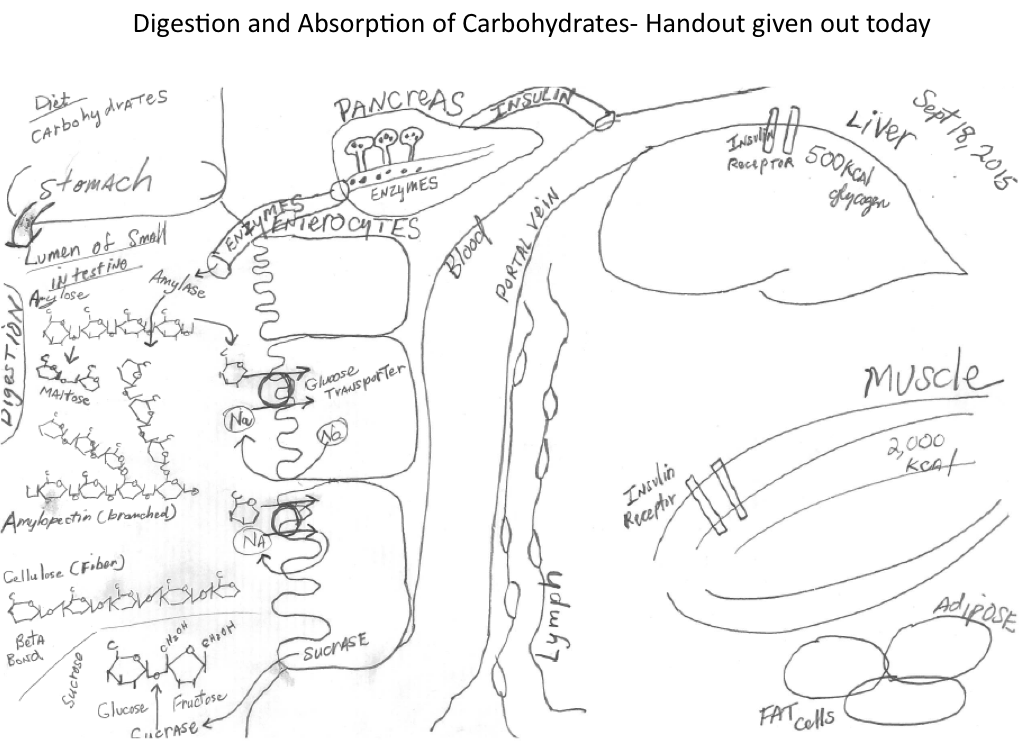
In order to learn about nutrition in the body, we need to know about all the different metabolic processes. One can ask the questions, “Is sugar bad for you? If so, why?” As we will find out, these are very complex questions. And we need to know how glucose is handled by the body in order to even come close to answering these questions. Today’s lecture involved a blackboard demonstration of carbohydrate digestion and glucose absorption. I spent a great deal of time on this, but I thought it was important to go through it in detail.
Digestion- What is interesting to me is that both amylose and amylopectin are digested so fast—see their glycemic indices. However, there are versions of amylose that are very long that are more slowly digested because the chain curls up on itself and the enzyme can’t get at it.
Also in the diagram is cellulose, which looks very similar to amylose (long chain of glucose molecules) but if you look closer it uses a different kind of bond (called Beta) that links the glucoses together and human enzymes can not cleave it.
Sucrose is only a disaccharide and it is only half glucose. The other half is fructose.
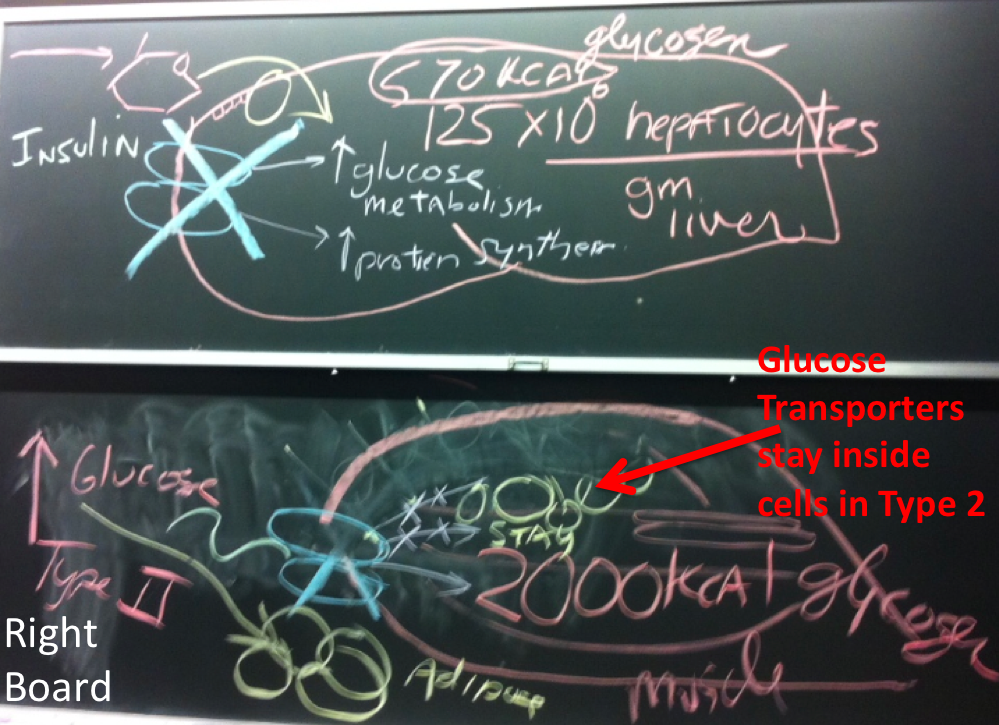
No matter what, the glucose transporter in the enterocyte requires sodium and there is co-transport of glucose and sodium into the enterocyte cell. Then the glucose enters the blood and flows fairly directly to the liver. The increase in glucose in blood stimulates the secretion of insulin from the pancreas. Insulin is important in removing glucose from the blood. We will go over this in great detail in the next lecture.
Here are some of the figures.



Information on Food Labeling is on the Internet
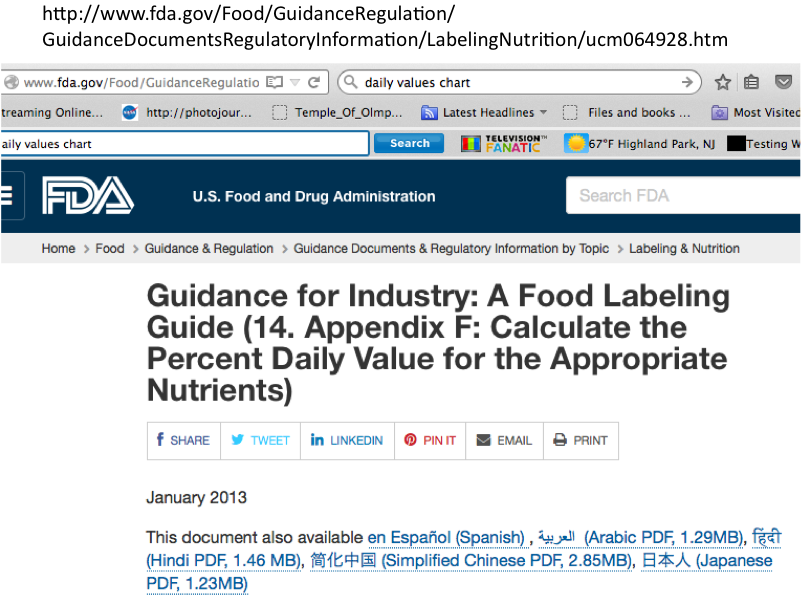
Information on Food Labeling is easily found on the internet:


Recent Comments