Dietary Reference Intakes- Where Do They Come From? Class 2, Jan 19, 2017

The Nutrient Balance Experiment – The Foundation of Nutrition

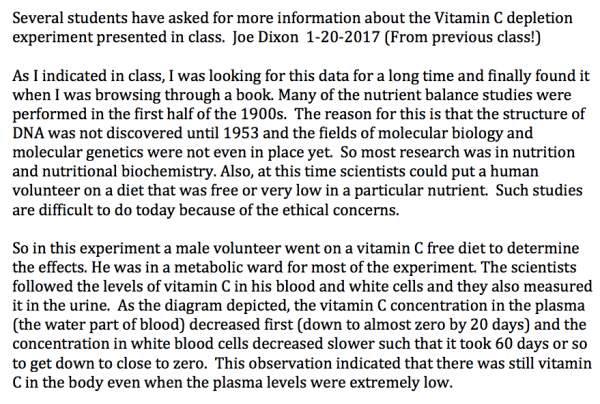
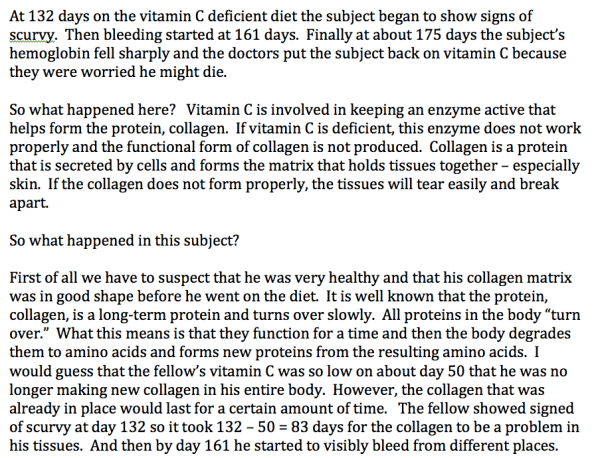
People would die on long voyages due to Scurvy

Why Britannia Ruled the Waves


First Class of Nutrition and Health- Jan 17, 2017
Welcome to the Class!

Synchronous Classrooms – Why?
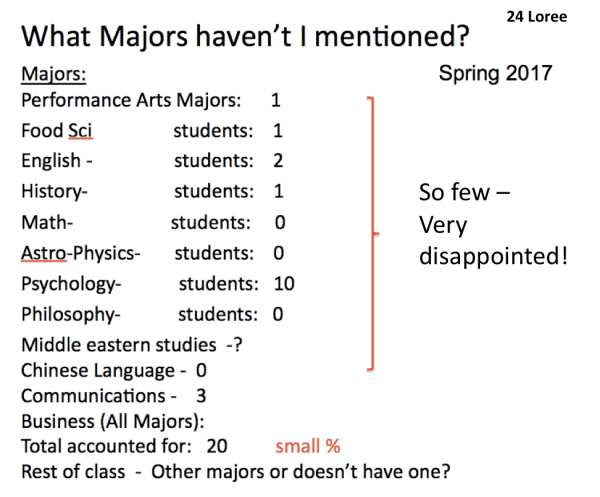
Class Survey in 24 Loree – Are the Classes similar in composition?



Goals for this Class
Student Comments from the Last Semester I taught (Fall 2015). All comments are on Sakai Site!
Synopsis of Class:






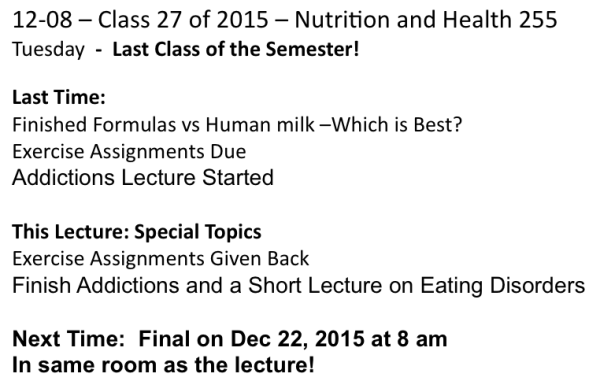
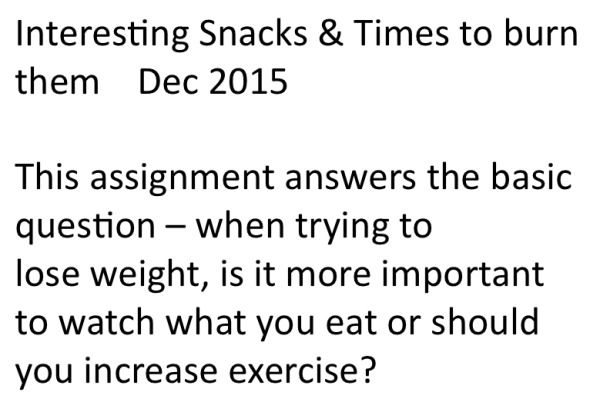


Addictions and Eating Disorders, Class on December 4, 2015

Question Concerning the Exercise Assignment
Question: Just wanted to ask you about the kcal content of favorite snacks part of the exercise assignment. When we put down our favorite snack is it ok if I use a decimal? For example, I chose 1 cup of popcorn as one of my snacks and thats about 64 calories but when you convert it to kcal you get 0.064.
Answer:
Thank you for your very important question. The Nutrition Calorie is the Kilocalorie (Kcal). If it wasn’t, then 1 cup of popcorn would be 0.064 Kcal as you say below. How would it be possible that 1 cup of popcorn would provide less than one Kcal when your energy expenditure is something like 2000 Kcal? If this were the case, you could eat 2000 cups of popcorn and still not reach your daily energy expenditure! The ANSWER is that it is not possible, and in fact, the calories listed on the package are Kcal, and not calories (in small case). This is a very common misconception, and I am happy you brought it up! Another student visited my office yesterday with the same question!
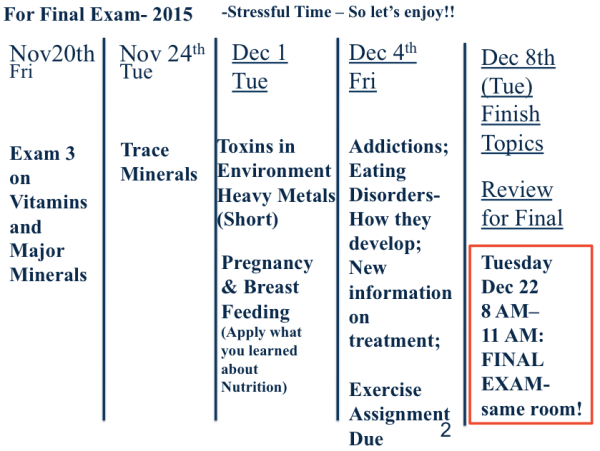
Special Topics In Nutrition, Class on Tuesday, December 1, 2015

Question Concerning Exercise Assignment
Question: I am a bit confused in what the first question is asking. Do you want us to compare the calories used vs the time or the calories used for structured activities vs walking?
Answer: Thanks for the question. I left it a little ambiguous which was a mistake. You can compare the specific Kcal expended per hour in a structured activity versus a basic, “NEAT”-type activity, or you could compare the total time spent in each type of activity on a daily or weekly basis and the general amount of Kcal expended. The second part of the first question is straight forward I think.
Questions on the Exercise Assignment, November 28, 2015
Here are some questions from students concerning the Exercise Assignment that was put on Sakai on Wednesday, November 25, 2015.
Question 1. What are structured Exercises and how do they differ from basic Exercises?
Answer: Structured activity is what you do in a gym or health club. Or maybe running or biking outside for a workout. Or doing exercises in your room for 30 minutes or so.
Basic or “NEAT” activities include walking and maybe gardening, working around the house, or going to the super market. Basic or “NEAT” may also include riding your bike to school or work.
On page 2 of the assignment, walking and gardening are basic or “NEAT” activities.
Question 2 (2 parts). For the 3rd page question one, are the structured activities the ones that are listed by you and we have to calculate? If yes then what would walking and basic activities be considered?
Answer: Structured activities are ones done in the gym or some kind of running or biking to get exercise. Walking, gardening and most kinds of working around the house or shopping are basic activities or “NEAT” activities. You can find the Kcal for NEAT activities on the Internet.
and for question #3, where would we find the total energy expenditure calculated by the USDA?
Answer: You already have this calculation. It would be the Target Calories (energy) at the top of the Nutrients Report in the USDA Print Out of your Dietary assignment!
Question 3. I have a question about the assignment. I’m a little confused with the calculations on the first page.
I calculated that my BMR is 2506 kcal/day
For PA, I chose Moderate exercise which says – Add 80% of BMR…….
Answer: Already I think you made an error in calculating your BMR! Check your calculation.
Here is an example: Say you are 60 kilograms (kg) (just an example).
Then your BMR per hr would be 0.9 Kcal/kg/hr x 60 kg = 54 Kcal/hr (Use for page 2)
Then there are 24 hr in a day, so:
BMR = 54 Kcal/hr X 24 hr/day = 1,296 Kcal/day
for PA, add 80% of this, so 0.8 x 1,296 = 1037 Kcal/day
then TEF, use 10 % of BMR + PA which is = 0.1 x (2333) = 233 Kcal/day
Then add them all up: 1,296 + 1037 + 233 = 2,566 Kcal, which is the total energy expenditure ( or requirement).
Does that help?




 How to cure obesity
Recent Comments